Proof of Trig Limits — Question 1

PDF ↗

Question 1

Prove that limx→0sin⁡xx=1.\lim_{x\to 0}\frac{\sin x}{x}=1.

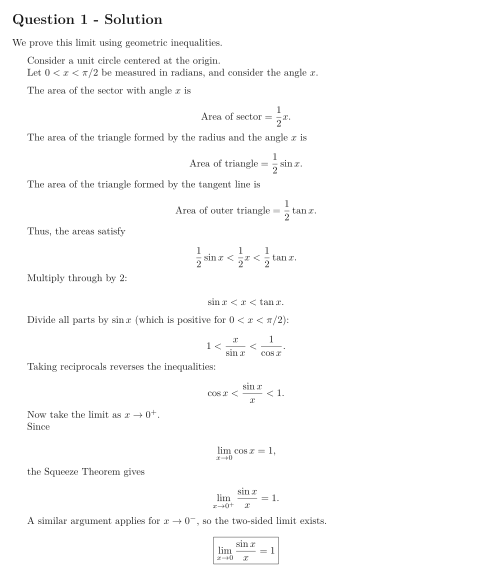
Original worksheet page 1: question and worked solution for 7-3-001
Show solutionHide solution

Question 1 - Solution

We prove this limit using geometric inequalities.

Consider a unit circle centered at the origin.

Let 0<x<π/20<x<\pi/2 be measured in radians, and consider the angle xx.

The area of the sector with angle xx is

Area of sector=12x.\text{Area of sector}=\frac{1}{2}x.

The area of the triangle formed by the radius and the angle xx is

Area of triangle=12sin⁡x.\text{Area of triangle}=\frac{1}{2}\sin x.

The area of the triangle formed by the tangent line is

Area of outer triangle=12tan⁡x.\text{Area of outer triangle}=\frac{1}{2}\tan x.

Thus, the areas satisfy

12sin⁡x<12x<12tan⁡x.\frac{1}{2}\sin x < \frac{1}{2}x < \frac{1}{2}\tan x.

Multiply through by 22:

sin⁡x<x<tan⁡x.\sin x < x < \tan x.

Divide all parts by sin⁡x\sin x (which is positive for 0<x<π/20<x<\pi/2):

1<xsin⁡x<1cos⁡x.1 < \frac{x}{\sin x} < \frac{1}{\cos x}.

Taking reciprocals reverses the inequalities:

cos⁡x<sin⁡xx<1.\cos x < \frac{\sin x}{x} < 1.

Now take the limit as x→0+x\to 0^+.

Since

limx→0cos⁡x=1,\lim_{x\to 0}\cos x=1,

the Squeeze Theorem gives

limx→0+sin⁡xx=1.\lim_{x\to 0^+}\frac{\sin x}{x}=1.

A similar argument applies for x→0−x\to 0^-, so the two-sided limit exists.

limx→0sin⁡xx=1\boxed{\lim_{x\to 0}\frac{\sin x}{x}=1}

Original worksheet page 2: question and worked solution for 7-3-001

Original worksheet layout. Use Enlarge or open the PDF for a closer view.