Proof of Trig Limits — Question 9

PDF ↗

Question 9

Prove that limx→0sin⁡(2x)tan⁡x=2.\lim_{x\to 0}\frac{\sin(2x)}{\tan x}=2.

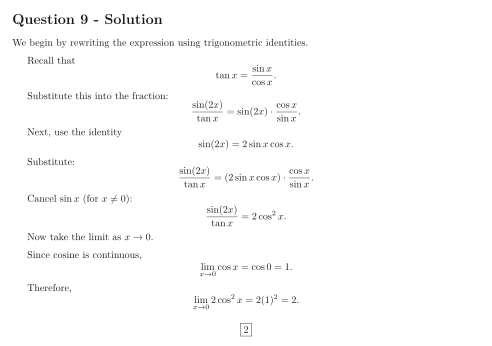
Original worksheet page 1: question and worked solution for 7-3-009
Show solutionHide solution

Question 9 - Solution

We begin by rewriting the expression using trigonometric identities.

Recall that tan⁡x=sin⁡xcos⁡x.\tan x=\frac{\sin x}{\cos x}.

Substitute this into the fraction: sin⁡(2x)tan⁡x=sin⁡(2x)⋅cos⁡xsin⁡x.\frac{\sin(2x)}{\tan x} = \sin(2x)\cdot\frac{\cos x}{\sin x}.

Next, use the identity sin⁡(2x)=2sin⁡xcos⁡x.\sin(2x)=2\sin x\cos x.

Substitute: sin⁡(2x)tan⁡x=(2sin⁡xcos⁡x)⋅cos⁡xsin⁡x.\frac{\sin(2x)}{\tan x} = (2\sin x\cos x)\cdot\frac{\cos x}{\sin x}.

Cancel sin⁡x\sin x (for x≠0x\neq 0): sin⁡(2x)tan⁡x=2cos⁡2x.\frac{\sin(2x)}{\tan x} = 2\cos^2 x.

Now take the limit as x→0x\to 0.

Since cosine is continuous, limx→0cos⁡x=cos⁡0=1.\lim_{x\to 0}\cos x=\cos 0=1.

Therefore, limx→02cos⁡2x=2(1)2=2.\lim_{x\to 0}2\cos^2 x = 2(1)^2 = 2.

2\boxed{2}

Original worksheet page 2: question and worked solution for 7-3-009

Original worksheet layout. Use Enlarge or open the PDF for a closer view.