Proof of Trig Limits — Question 10

PDF ↗

Question 10

Prove that limx→0tan⁡x−xx=0.\lim_{x\to 0}\frac{\tan x - x}{x}=0.

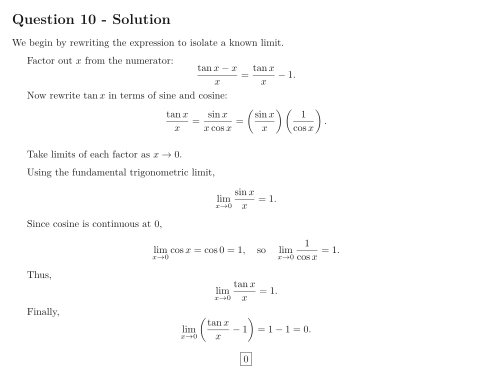
Original worksheet page 1: question and worked solution for 7-3-010
Show solutionHide solution

Question 10 - Solution

We begin by rewriting the expression to isolate a known limit.

Factor out xx from the numerator: tan⁡x−xx=tan⁡xx−1.\frac{\tan x - x}{x} = \frac{\tan x}{x}-1.

Now rewrite tan⁡x\tan x in terms of sine and cosine: tan⁡xx=sin⁡xxcos⁡x=(sin⁡xx)(1cos⁡x).\frac{\tan x}{x} = \frac{\sin x}{x\cos x} = \left(\frac{\sin x}{x}\right)\left(\frac{1}{\cos x}\right).

Take limits of each factor as x→0x\to 0.

Using the fundamental trigonometric limit, limx→0sin⁡xx=1.\lim_{x\to 0}\frac{\sin x}{x}=1.

Since cosine is continuous at 00, limx→0cos⁡x=cos⁡0=1,solimx→01cos⁡x=1.\lim_{x\to 0}\cos x=\cos 0=1, \quad \text{so} \quad \lim_{x\to 0}\frac{1}{\cos x}=1.

Thus, limx→0tan⁡xx=1.\lim_{x\to 0}\frac{\tan x}{x}=1.

Finally, limx→0(tan⁡xx−1)=1−1=0.\lim_{x\to 0}\left(\frac{\tan x}{x}-1\right)=1-1=0.

0\boxed{0}

Original worksheet page 2: question and worked solution for 7-3-010

Original worksheet layout. Use Enlarge or open the PDF for a closer view.