Proofs of Derivative Applications Facts — Question 1

PDF ↗

Question 1

Assume that ff has a local maximum at x=ax=a and that ff is differentiable at x=ax=a. Prove that f′(a)=0.f'(a)=0.

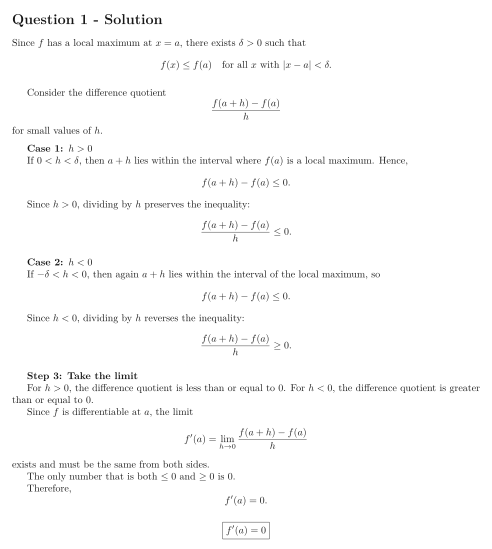
Original worksheet page 1: question and worked solution for 7-4-001
Show solutionHide solution

Question 1 - Solution

Since ff has a local maximum at x=ax=a, there exists δ>0\delta>0 such that f(x)≤f(a)for all x with |x−a|<δ.f(x)\le f(a) \quad\text{for all }x\text{ with }|x-a|<\delta.

Consider the difference quotient f(a+h)−f(a)h\frac{f(a+h)-f(a)}{h} for small values of hh.

Case 1: h>0h>0

If 0<h<δ0<h<\delta, then a+ha+h lies within the interval where f(a)f(a) is a local maximum. Hence, f(a+h)−f(a)≤0.f(a+h)-f(a)\le 0.

Since h>0h>0, dividing by hh preserves the inequality: f(a+h)−f(a)h≤0.\frac{f(a+h)-f(a)}{h}\le 0.

Case 2: h<0h<0

If −δ<h<0-\delta<h<0, then again a+ha+h lies within the interval of the local maximum, so f(a+h)−f(a)≤0.f(a+h)-f(a)\le 0.

Since h<0h<0, dividing by hh reverses the inequality: f(a+h)−f(a)h≥0.\frac{f(a+h)-f(a)}{h}\ge 0.

Step 3: Take the limit

For h>0h>0, the difference quotient is less than or equal to 00. For h<0h<0, the difference quotient is greater than or equal to 00.

Since ff is differentiable at aa, the limit f′(a)=limh→0f(a+h)−f(a)hf'(a)=\lim_{h\to 0}\frac{f(a+h)-f(a)}{h} exists and must be the same from both sides.

The only number that is both ≤0\le 0 and ≥0\ge 0 is 00.

Therefore, f′(a)=0.f'(a)=0.

f′(a)=0\boxed{f'(a)=0}

Original worksheet page 2: question and worked solution for 7-4-001

Original worksheet layout. Use Enlarge or open the PDF for a closer view.