Proofs of Derivative Applications Facts — Question 2

PDF ↗

Question 2

Assume that ff is continuous on [a,b][a,b], differentiable on (a,b)(a,b), and f(a)=f(b).f(a)=f(b). Prove that there exists a number c∈(a,b)c\in(a,b) such that f′(c)=0.f'(c)=0.

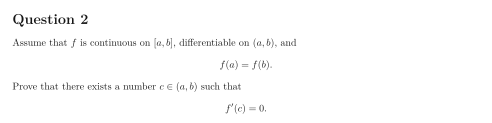
Original worksheet page 1: question and worked solution for 7-4-002
Show solutionHide solution

Question 2 - Solution

Since ff is continuous on the closed interval [a,b][a,b], the Extreme Value Theorem guarantees that ff attains both a maximum and a minimum on [a,b][a,b].

Let M=maxx∈[a,b]f(x),m=minx∈[a,b]f(x).M=\max_{x\in[a,b]} f(x), \qquad m=\min_{x\in[a,b]} f(x).

If M=mM=m, then ff is constant on [a,b][a,b], and hence f′(x)=0for all x∈(a,b).f'(x)=0 \quad\text{for all }x\in(a,b). In particular, there exists c∈(a,b)c\in(a,b) such that f′(c)=0f'(c)=0.

Now assume that M≠mM\neq m. Since f(a)=f(b)f(a)=f(b), the maximum or minimum cannot occur at both endpoints.

Thus, at least one of the extreme values MM or mm must occur at some point c∈(a,b)c\in(a,b).

At such a point cc, the function ff has either a local maximum or a local minimum. Because ff is differentiable at cc, the derivative must vanish there.

Therefore, f′(c)=0.f'(c)=0.
There exists c∈(a,b) such that f′(c)=0\boxed{\text{There exists }c\in(a,b)\text{ such that }f'(c)=0}

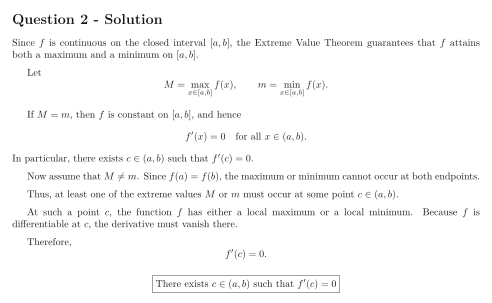
Original worksheet page 2: question and worked solution for 7-4-002

Original worksheet layout. Use Enlarge or open the PDF for a closer view.