Proofs of Derivative Applications Facts — Question 7

PDF ↗

Question 7

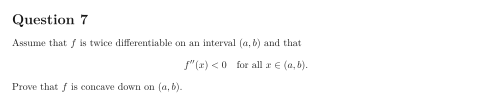
Assume that ff is twice differentiable on an interval (a,b)(a,b) and that f″(x)<0for all x∈(a,b).f''(x)<0 \quad\text{for all }x\in(a,b). Prove that ff is concave down on (a,b)(a,b).

Original worksheet page 1: question and worked solution for 7-4-007
Show solutionHide solution

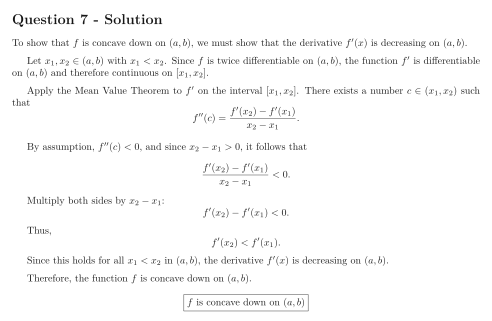
Question 7 - Solution

To show that ff is concave down on (a,b)(a,b), we must show that the derivative f′(x)f'(x) is decreasing on (a,b)(a,b).

Let x1,x2∈(a,b)x_1,x_2\in(a,b) with x1<x2x_1<x_2. Since ff is twice differentiable on (a,b)(a,b), the function f′f' is differentiable on (a,b)(a,b) and therefore continuous on [x1,x2][x_1,x_2].

Apply the Mean Value Theorem to f′f' on the interval [x1,x2][x_1,x_2]. There exists a number c∈(x1,x2)c\in(x_1,x_2) such that f″(c)=f′(x2)−f′(x1)x2−x1.f''(c)=\frac{f'(x_2)-f'(x_1)}{x_2-x_1}.

By assumption, f″(c)<0f''(c)<0, and since x2−x1>0x_2-x_1>0, it follows that f′(x2)−f′(x1)x2−x1<0.\frac{f'(x_2)-f'(x_1)}{x_2-x_1}<0.

Multiply both sides by x2−x1x_2-x_1: f′(x2)−f′(x1)<0.f'(x_2)-f'(x_1)<0.

Thus, f′(x2)<f′(x1).f'(x_2)<f'(x_1).

Since this holds for all x1<x2x_1<x_2 in (a,b)(a,b), the derivative f′(x)f'(x) is decreasing on (a,b)(a,b).

Therefore, the function ff is concave down on (a,b)(a,b).

f is concave down on (a,b)\boxed{f\text{ is concave down on }(a,b)}

Original worksheet page 2: question and worked solution for 7-4-007

Original worksheet layout. Use Enlarge or open the PDF for a closer view.