Proof of Various Integral Properties — Question 1

PDF ↗

Question 1

Assume that ff is integrable on the interval [a,b][a,b] and that cc is a constant. Prove that ∫abcf(x)dx=c∫abf(x)dx.\int_a^b c\,f(x)\,dx = c\int_a^b f(x)\,dx.

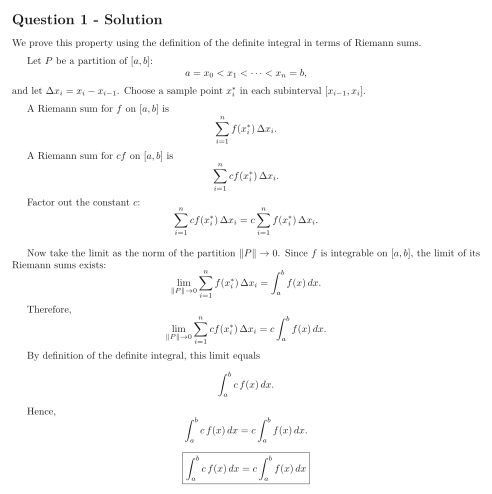
Original worksheet page 1: question and worked solution for 7-5-001
Show solutionHide solution

Question 1 - Solution

We prove this property using the definition of the definite integral in terms of Riemann sums.

Let PP be a partition of [a,b][a,b]: a=x0<x1<⋯<xn=b,a=x_0<x_1<\cdots<x_n=b, and let Δxi=xi−xi−1\Delta x_i = x_i-x_{i-1}. Choose a sample point xi*x_i^* in each subinterval [xi−1,xi][x_{i-1},x_i].

A Riemann sum for ff on [a,b][a,b] is ∑i=1nf(xi*)Δxi.\sum_{i=1}^n f(x_i^*)\,\Delta x_i.

A Riemann sum for cfc f on [a,b][a,b] is ∑i=1ncf(xi*)Δxi.\sum_{i=1}^n c f(x_i^*)\,\Delta x_i.

Factor out the constant cc: ∑i=1ncf(xi*)Δxi=c∑i=1nf(xi*)Δxi.\sum_{i=1}^n c f(x_i^*)\,\Delta x_i = c\sum_{i=1}^n f(x_i^*)\,\Delta x_i.

Now take the limit as the norm of the partition ∥P∥→0\|P\|\to 0. Since ff is integrable on [a,b][a,b], the limit of its Riemann sums exists: lim∥P∥→0∑i=1nf(xi*)Δxi=∫abf(x)dx.\lim_{\|P\|\to 0}\sum_{i=1}^n f(x_i^*)\,\Delta x_i = \int_a^b f(x)\,dx.

Therefore, lim∥P∥→0∑i=1ncf(xi*)Δxi=c∫abf(x)dx.\lim_{\|P\|\to 0}\sum_{i=1}^n c f(x_i^*)\,\Delta x_i = c\int_a^b f(x)\,dx.

By definition of the definite integral, this limit equals ∫abcf(x)dx.\int_a^b c\,f(x)\,dx.

Hence, ∫abcf(x)dx=c∫abf(x)dx.\int_a^b c\,f(x)\,dx = c\int_a^b f(x)\,dx.

∫abcf(x)dx=c∫abf(x)dx\boxed{\int_a^b c\,f(x)\,dx = c\int_a^b f(x)\,dx}

Original worksheet page 2: question and worked solution for 7-5-001

Original worksheet layout. Use Enlarge or open the PDF for a closer view.