Question 5
Assume that is a continuous, nonnegative function on . Prove that the volume of the solid obtained by revolving the region bounded by , the -axis, and the lines and about the -axis is
Show solutionHide solution
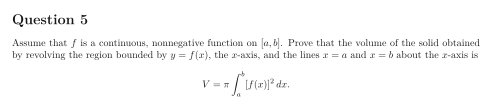
Question 5 - Solution
We derive the formula using the idea of approximating the solid with thin disks.
Partition the interval into subintervals and let
Choose a sample point in each subinterval .
Over a small interval , the graph of is approximately constant at height . When this vertical strip is revolved about the -axis, it forms a thin circular disk.
The radius of the disk is
The area of the circular face of the disk is
Since the thickness of the disk is , its volume is approximately
Adding the volumes of all disks gives an approximation to the total volume:
As the partition is refined and the maximum subinterval length approaches zero, these disks more accurately fill the solid. Because is continuous on , the limit of the sum exists.
Taking the limit yields