Summation Notation — Question 4

PDF ↗

Question 4

Prove that for any positive integer nn, ∑k=1n(2k−1)=n2.\sum_{k=1}^{n} (2k-1) = n^2.

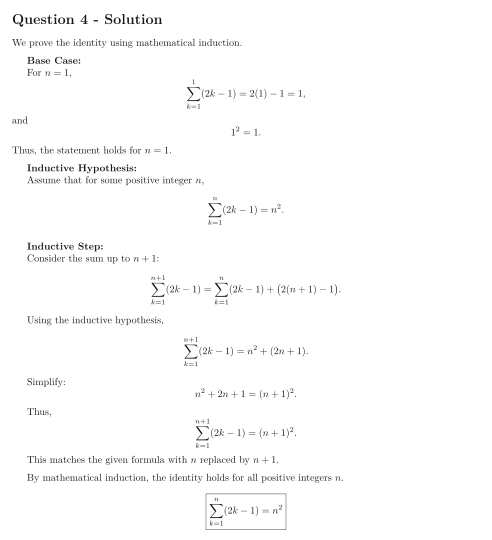
Original worksheet page 1: question and worked solution for 7-8-004
Show solutionHide solution

Question 4 - Solution

We prove the identity using mathematical induction.

Base Case:

For n=1n=1, ∑k=11(2k−1)=2(1)−1=1,\sum_{k=1}^{1} (2k-1) = 2(1)-1 = 1, and 12=1.1^2 = 1. Thus, the statement holds for n=1n=1.

Inductive Hypothesis:

Assume that for some positive integer nn, ∑k=1n(2k−1)=n2.\sum_{k=1}^{n} (2k-1) = n^2.

Inductive Step:

Consider the sum up to n+1n+1: ∑k=1n+1(2k−1)=∑k=1n(2k−1)+(2(n+1)−1).\sum_{k=1}^{n+1} (2k-1) = \sum_{k=1}^{n} (2k-1) + \bigl(2(n+1)-1\bigr).

Using the inductive hypothesis, ∑k=1n+1(2k−1)=n2+(2n+1).\sum_{k=1}^{n+1} (2k-1) = n^2 + (2n+1).

Simplify: n2+2n+1=(n+1)2.n^2 + 2n + 1 = (n+1)^2.

Thus, ∑k=1n+1(2k−1)=(n+1)2.\sum_{k=1}^{n+1} (2k-1) = (n+1)^2.

This matches the given formula with nn replaced by n+1n+1.

By mathematical induction, the identity holds for all positive integers nn.

∑k=1n(2k−1)=n2\boxed{\sum_{k=1}^{n} (2k-1) = n^2}

Original worksheet page 2: question and worked solution for 7-8-004

Original worksheet layout. Use Enlarge or open the PDF for a closer view.