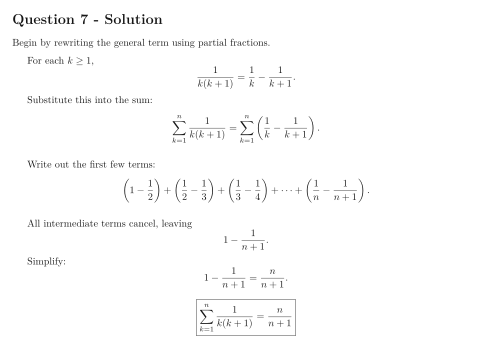
Question 7 Prove that for any positive integer nn, ∑k=1n1k(k+1)=nn+1.\sum_{k=1}^{n} \frac{1}{k(k+1)} = \frac{n}{n+1}. Show solutionHide solution+Question 7 - Solution Begin by rewriting the general term using partial fractions. For each k≥1k\ge 1, 1k(k+1)=1k−1k+1.\frac{1}{k(k+1)} = \frac{1}{k}-\frac{1}{k+1}. Substitute this into the sum: ∑k=1n1k(k+1)=∑k=1n(1k−1k+1).\sum_{k=1}^{n} \frac{1}{k(k+1)} = \sum_{k=1}^{n}\left(\frac{1}{k}-\frac{1}{k+1}\right). Write out the first few terms: (1−12)+(12−13)+(13−14)+⋯+(1n−1n+1).\left(1-\frac{1}{2}\right) + \left(\frac{1}{2}-\frac{1}{3}\right) + \left(\frac{1}{3}-\frac{1}{4}\right) +\cdots+ \left(\frac{1}{n}-\frac{1}{n+1}\right). All intermediate terms cancel, leaving 1−1n+1.1-\frac{1}{n+1}. Simplify: 1−1n+1=nn+1.1-\frac{1}{n+1} = \frac{n}{n+1}. ∑k=1n1k(k+1)=nn+1\boxed{\sum_{k=1}^{n} \frac{1}{k(k+1)}=\frac{n}{n+1}}