Constant of Integration — Question 1

PDF ↗

Question 1

Suppose that FF and GG are antiderivatives of the same function ff on an interval II. Prove that there exists a constant CC such that F(x)=G(x)+Cfor all x∈I.F(x)=G(x)+C \quad\text{for all }x\in I.

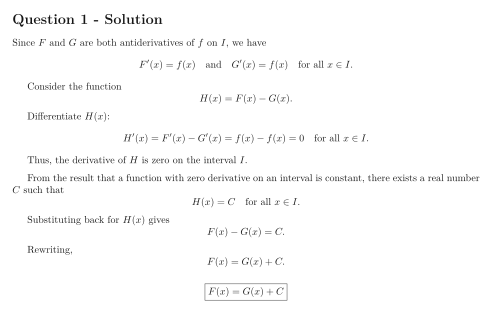
Original worksheet page 1: question and worked solution for 7-9-001
Show solutionHide solution

Question 1 - Solution

Since FF and GG are both antiderivatives of ff on II, we have F′(x)=f(x)andG′(x)=f(x)for all x∈I.F'(x)=f(x) \quad\text{and}\quad G'(x)=f(x) \quad\text{for all }x\in I.

Consider the function H(x)=F(x)−G(x).H(x)=F(x)-G(x).

Differentiate H(x)H(x): H′(x)=F′(x)−G′(x)=f(x)−f(x)=0for all x∈I.H'(x)=F'(x)-G'(x)=f(x)-f(x)=0 \quad\text{for all }x\in I.

Thus, the derivative of HH is zero on the interval II.

From the result that a function with zero derivative on an interval is constant, there exists a real number CC such that H(x)=Cfor all x∈I.H(x)=C \quad\text{for all }x\in I.

Substituting back for H(x)H(x) gives F(x)−G(x)=C.F(x)-G(x)=C.

Rewriting, F(x)=G(x)+C.F(x)=G(x)+C.

F(x)=G(x)+C\boxed{F(x)=G(x)+C}

Original worksheet page 2: question and worked solution for 7-9-001

Original worksheet layout. Use Enlarge or open the PDF for a closer view.