Constant of Integration — Question 8

PDF ↗

Question 8

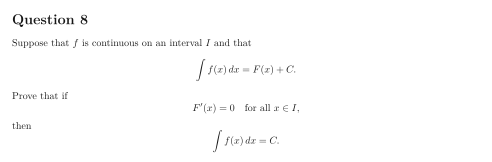
Suppose that ff is continuous on an interval II and that ∫f(x)dx=F(x)+C.\int f(x)\,dx = F(x)+C. Prove that if F′(x)=0for all x∈I,F'(x)=0 \quad\text{for all }x\in I, then ∫f(x)dx=C.\int f(x)\,dx = C.

Original worksheet page 1: question and worked solution for 7-9-008
Show solutionHide solution

Question 8 - Solution

Since ∫f(x)dx=F(x)+C,\int f(x)\,dx = F(x)+C, the function F(x)F(x) is an antiderivative of ff.

Given that F′(x)=0for all x∈I,F'(x)=0 \quad\text{for all }x\in I, it follows from the Mean Value Theorem that FF is constant on the interval II.

Thus, there exists a real number KK such that F(x)=Kfor all x∈I.F(x)=K \quad\text{for all }x\in I.

Substitute this into the expression for the indefinite integral: ∫f(x)dx=K+C.\int f(x)\,dx = K + C.

Since K+CK+C is itself a constant, we may write ∫f(x)dx=C′.\int f(x)\,dx = C'.

Therefore, if the derivative of an antiderivative is zero on an interval, the indefinite integral reduces to a constant.
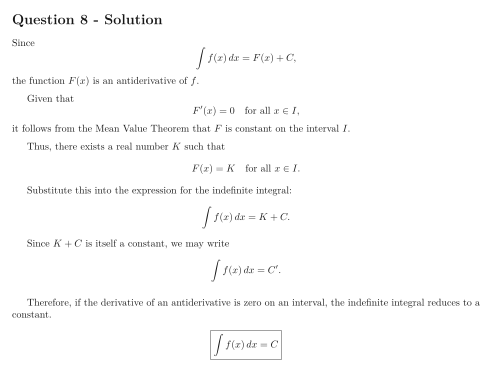
∫f(x)dx=C\boxed{\int f(x)\,dx = C}

Original worksheet page 2: question and worked solution for 7-9-008

Original worksheet layout. Use Enlarge or open the PDF for a closer view.