Question 10
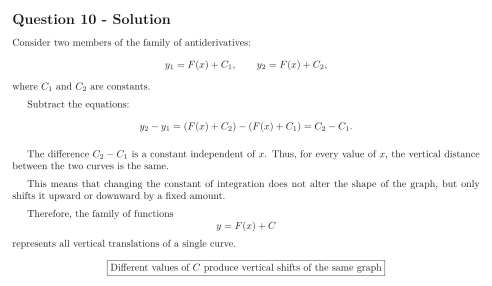
Suppose that is continuous on an interval and that Show that the family of curves consists of vertical translations of a single curve.
Show solutionHide solution
Question 10 - Solution
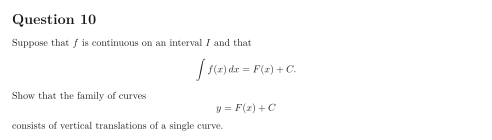
Consider two members of the family of antiderivatives: where and are constants.
Subtract the equations:
The difference is a constant independent of . Thus, for every value of , the vertical distance between the two curves is the same.
This means that changing the constant of integration does not alter the shape of the graph, but only shifts it upward or downward by a fixed amount.
Therefore, the family of functions represents all vertical translations of a single curve.