Integrals Involving Trig Functions — Question 7

PDF ↗

Question 7

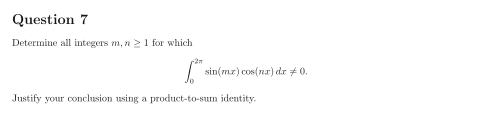
Determine all integers m,n≥1m,n\geq1 for which ∫02πsin⁡(mx)cos⁡(nx)dx≠0.\int_0^{2\pi}\sin(mx)\cos(nx)\,dx\ne0. Justify your conclusion using a product-to-sum identity.

Original worksheet page 1: question and worked solution for 1-2-007
Show solutionHide solution

Question 7 – Solution

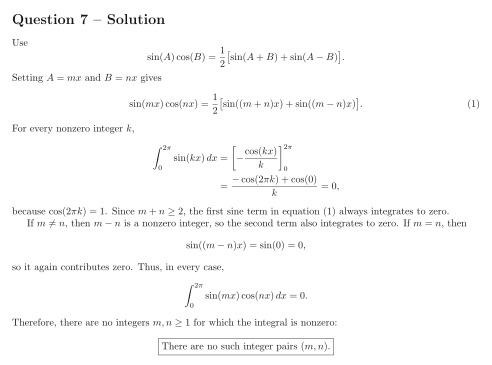
Use sin⁡(A)cos⁡(B)=12[sin⁡(A+B)+sin⁡(A−B)].\sin(A)\cos(B)=\frac12\bigl[\sin(A+B)+\sin(A-B)\bigr]. Setting A=mxA=mx and B=nxB=nx gives sin⁡(mx)cos⁡(nx)=12[sin⁡((m+n)x)+sin⁡((m−n)x)].\sin(mx)\cos(nx) =\frac12\bigl[\sin((m+n)x)+\sin((m-n)x)\bigr]. \tag{1} For every nonzero integer kk, ∫02πsin⁡(kx)dx=[−cos⁡(kx)k]02π=−cos⁡(2πk)+cos⁡(0)k=0,\begin{align*} \int_0^{2\pi}\sin(kx)\,dx &=\left[-\frac{\cos(kx)}k\right]_0^{2\pi}\\ &=\frac{-\cos(2\pi k)+\cos(0)}k=0, \end{align*} because cos⁡(2πk)=1\cos(2\pi k)=1. Since m+n≥2m+n\geq2, the first sine term in equation (1) always integrates to zero.

If m≠nm\ne n, then m−nm-n is a nonzero integer, so the second term also integrates to zero. If m=nm=n, then sin⁡((m−n)x)=sin⁡(0)=0,\sin((m-n)x)=\sin(0)=0, so it again contributes zero. Thus, in every case, ∫02πsin⁡(mx)cos⁡(nx)dx=0.\int_0^{2\pi}\sin(mx)\cos(nx)\,dx=0. Therefore, there are no integers m,n≥1m,n\geq1 for which the integral is nonzero: There are no such integer pairs (m,n).\boxed{\text{There are no such integer pairs }(m,n).}

Original worksheet page 2: question and worked solution for 1-2-007

Original worksheet layout. Use Enlarge or open the PDF for a closer view.