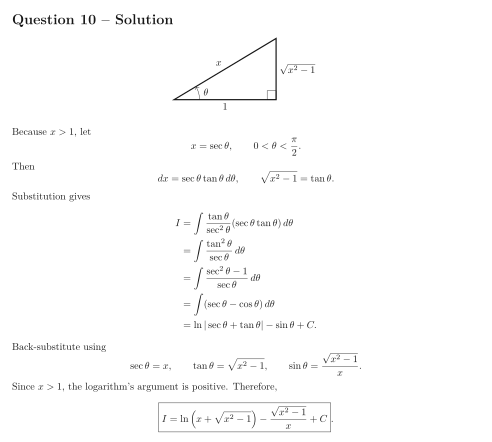
Question 10 Use a trigonometric or hyperbolic substitution to evaluate ∫x2−1x2dx,x>1.\int\frac{\sqrt{x^2-1}}{x^2}\,dx,\qquad x>1. Show solutionHide solution+Question 10 – Solution See the diagram in the original worksheet below. Because x>1x>1, let x=secθ,0<θ<π2.x=\sec\theta,\qquad 0<\theta<\frac\pi2. Then dx=secθtanθdθ,x2−1=tanθ.dx=\sec\theta\tan\theta\,d\theta,\qquad \sqrt{x^2-1}=\tan\theta. Substitution gives I=∫tanθsec2θ(secθtanθ)dθ=∫tan2θsecθdθ=∫sec2θ−1secθdθ=∫(secθ−cosθ)dθ=ln|secθ+tanθ|−sinθ+C.\begin{align*} I&=\int\frac{\tan\theta}{\sec^2\theta} (\sec\theta\tan\theta)\,d\theta\\ &=\int\frac{\tan^2\theta}{\sec\theta}\,d\theta\\ &=\int\frac{\sec^2\theta-1}{\sec\theta}\,d\theta\\ &=\int(\sec\theta-\cos\theta)\,d\theta\\ &=\ln|\sec\theta+\tan\theta|-\sin\theta+C. \end{align*} Back-substitute using secθ=x,tanθ=x2−1,sinθ=x2−1x.\sec\theta=x,\qquad \tan\theta=\sqrt{x^2-1},\qquad \sin\theta=\frac{\sqrt{x^2-1}}x. Since x>1x>1, the logarithm’s argument is positive. Therefore, I=ln(x+x2−1)−x2−1x+C.\boxed{\displaystyle I=\ln\left(x+\sqrt{x^2-1}\right) -\frac{\sqrt{x^2-1}}x+C}.