Arc Length — Question 4

PDF ↗

Question 4

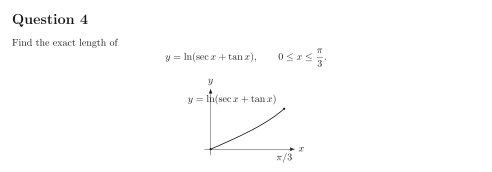
Find the exact length of y=ln⁡(sec⁡x+tan⁡x),0≤x≤π3.y=\ln(\sec x+\tan x),\qquad0\le x\le\frac\pi3.

See the diagram in the original worksheet below.

Original worksheet page 1: question and worked solution for 2-1-004
Show solutionHide solution

Question 4 – Solution

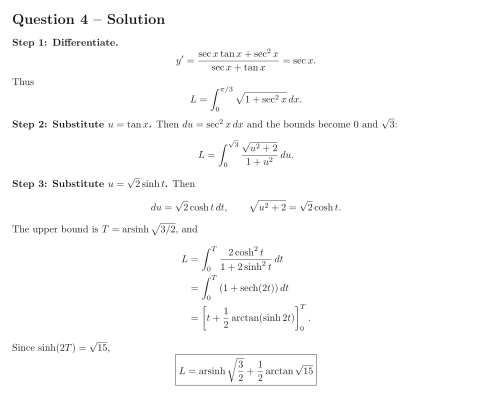
Step 1: Differentiate. y′=sec⁡xtan⁡x+sec⁡2xsec⁡x+tan⁡x=sec⁡x.y'=\frac{\sec x\tan x+\sec^2x}{\sec x+\tan x}=\sec x. Thus L=∫0π/31+sec⁡2xdx.L=\int_0^{\pi/3}\sqrt{1+\sec^2x}\,dx. Step 2: Substitute u=tan⁡xu=\tan x. Then du=sec⁡2xdxdu=\sec^2x\,dx and the bounds become 00 and 3\sqrt3: L=∫03u2+21+u2du.L=\int_0^{\sqrt3}\frac{\sqrt{u^2+2}}{1+u^2}\,du. Step 3: Substitute u=2sinh⁡tu=\sqrt2\sinh t. Then du=2cosh⁡tdt,u2+2=2cosh⁡t.du=\sqrt2\cosh t\,dt,\qquad\sqrt{u^2+2}=\sqrt2\cosh t. The upper bound is T=arsinh⁡3/2T=\operatorname{arsinh}\sqrt{3/2}, and L=∫0T2cosh⁡2t1+2sinh⁡2tdt=∫0T(1+sech(2t))dt=[t+12arctan(sinh2t)]0T.\begin{align*} L&=\int_0^T\frac{2\cosh^2t}{1+2\sinh^2t}\,dt\\ &=\int_0^T\left(1+\operatorname{sech}(2t)\right)dt\\ &=\left[t+\frac12\arctan(\sinh2t)\right]_0^T. \end{align*} Since sinh⁡(2T)=15\sinh(2T)=\sqrt{15}, L=arsinh⁡32+12arctan⁡15\boxed{L=\operatorname{arsinh}\sqrt{\frac32} +\frac12\arctan\sqrt{15}}

Original worksheet page 2: question and worked solution for 2-1-004

Original worksheet layout. Use Enlarge or open the PDF for a closer view.