Question 8
Problem
A particle has velocity . Does its path have a vertical tangent? Analyze the tangent and direction of motion at any stationary time.
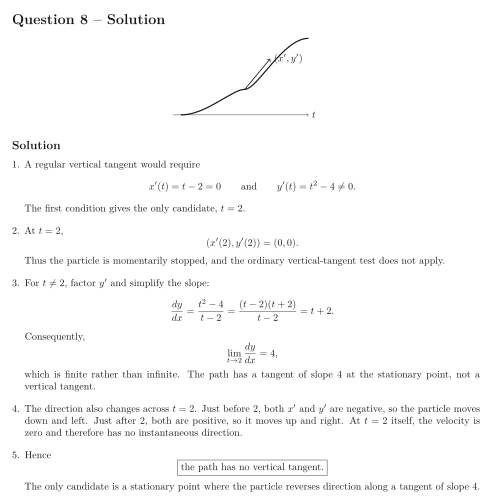
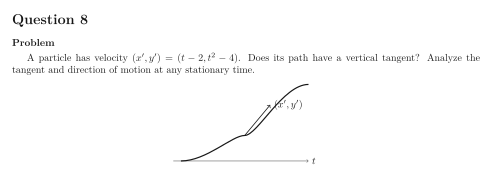
See the diagram in the original worksheet below.
Show solutionHide solution
Question 8 – Solution
See the diagram in the original worksheet below.
Solution
A regular vertical tangent would require The first condition gives the only candidate, .
At , Thus the particle is momentarily stopped, and the ordinary vertical-tangent test does not apply.
For , factor and simplify the slope: Consequently, which is finite rather than infinite. The path has a tangent of slope at the stationary point, not a vertical tangent.
The direction also changes across . Just before , both and are negative, so the particle moves down and left. Just after , both are positive, so it moves up and right. At itself, the velocity is zero and therefore has no instantaneous direction.
Hence The only candidate is a stationary point where the particle reverses direction along a tangent of slope .