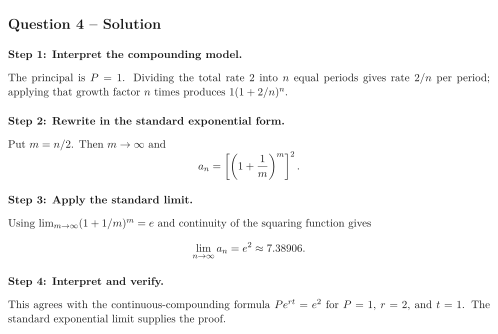
Question 4
Let .
Interpret as the balance produced by compounding a principal of at a total rate of over one time unit, using periods.
Evaluate using the standard exponential limit.
Give a decimal approximation of the limiting balance.
Show solutionHide solution
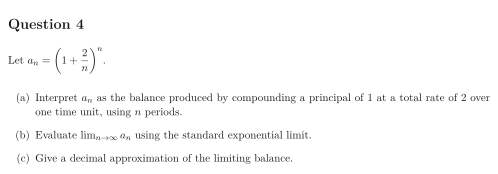
Question 4 – Solution
Step 1: Interpret the compounding model.
The principal is . Dividing the total rate into equal periods gives rate per period; applying that growth factor times produces .
Step 2: Rewrite in the standard exponential form.
Put . Then and
Step 3: Apply the standard limit.
Using and continuity of the squaring function gives
Step 4: Interpret and verify.
This agrees with the continuous-compounding formula for , , and . The standard exponential limit supplies the proof.