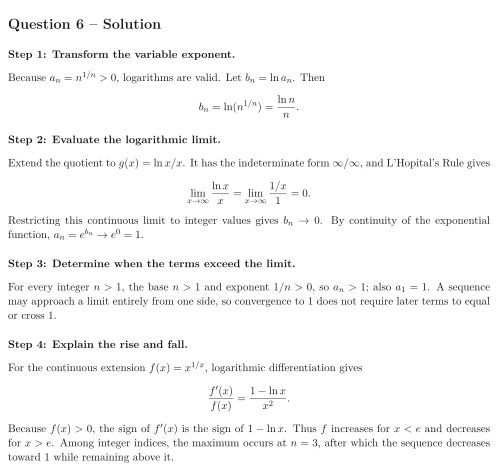
Question 6
Let for .
Use logarithms to find .
For which integers is ?
Use the continuous extension to explain why the terms first rise and then decrease, even though their limit is .
Show solutionHide solution
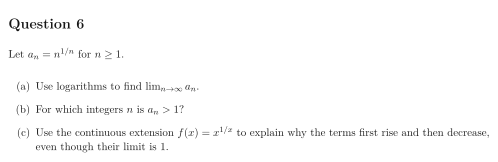
Question 6 – Solution
Step 1: Transform the variable exponent.
Because , logarithms are valid. Let . Then
Step 2: Evaluate the logarithmic limit.
Extend the quotient to . It has the indeterminate form , and L’Hopital’s Rule gives Restricting this continuous limit to integer values gives . By continuity of the exponential function, .
Step 3: Determine when the terms exceed the limit.
For every integer , the base and exponent , so ; also . A sequence may approach a limit entirely from one side, so convergence to does not require later terms to equal or cross .
Step 4: Explain the rise and fall.
For the continuous extension , logarithmic differentiation gives Because , the sign of is the sign of . Thus increases for and decreases for . Among integer indices, the maximum occurs at , after which the sequence decreases toward while remaining above it.