Sequences — Question 9

PDF ↗

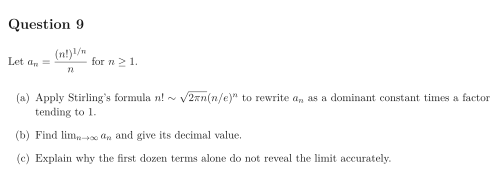
Question 9

Let an=(n!)1/nna_n=\dfrac{(n!)^{1/n}}{n} for n≥1n\ge1.

  1. Apply Stirling’s formula n!∼2πn(n/e)nn!\sim\sqrt{2\pi n}(n/e)^n to rewrite ana_n as a dominant constant times a factor tending to 11.

  2. Find lim⁡n→∞an\lim_{n\to\infty}a_n and give its decimal value.

  3. Explain why the first dozen terms alone do not reveal the limit accurately.
Original worksheet page 1: question and worked solution for 4-1-009
Show solutionHide solution

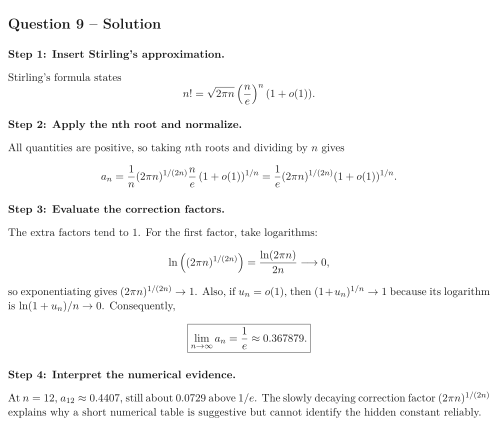
Question 9 – Solution

Step 1: Insert Stirling’s approximation.

Stirling’s formula states n!=2πn(ne)n(1+o(1)).n!=\sqrt{2\pi n}\left(\frac ne\right)^n(1+o(1)).

Step 2: Apply the nth root and normalize.

All quantities are positive, so taking nnth roots and dividing by nn gives an=1n(2πn)1/(2n)ne(1+o(1))1/n=1e(2πn)1/(2n)(1+o(1))1/n.a_n=\frac1n(2\pi n)^{1/(2n)}\frac ne\,(1+o(1))^{1/n} =\frac1e(2\pi n)^{1/(2n)}(1+o(1))^{1/n}.

Step 3: Evaluate the correction factors.

The extra factors tend to 11. For the first factor, take logarithms: ln⁡((2πn)1/(2n))=ln⁡(2πn)2n→0,\ln\left((2\pi n)^{1/(2n)}\right)=\frac{\ln(2\pi n)}{2n}\longrightarrow0, so exponentiating gives (2πn)1/(2n)→1(2\pi n)^{1/(2n)}\to1. Also, if un=o(1)u_n=o(1), then (1+un)1/n→1(1+u_n)^{1/n}\to1 because its logarithm is ln⁡(1+un)/n→0\ln(1+u_n)/n\to0. Consequently, limn→∞an=1e≈0.367879.\boxed{\lim_{n\to\infty}a_n=\frac1e\approx0.367879.}

Step 4: Interpret the numerical evidence.

At n=12n=12, a12≈0.4407a_{12}\approx0.4407, still about 0.07290.0729 above 1/e1/e. The slowly decaying correction factor (2πn)1/(2n)(2\pi n)^{1/(2n)} explains why a short numerical table is suggestive but cannot identify the hidden constant reliably.
Original worksheet page 2: question and worked solution for 4-1-009

Original worksheet layout. Use Enlarge or open the PDF for a closer view.