Strategy for Series — Question 9

PDF ↗

Question 9

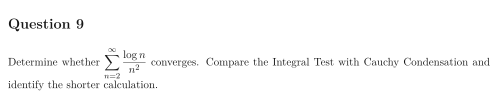
Determine whether ∑n=2∞log⁡nn2\displaystyle\sum_{n=2}^{\infty}\frac{\log n}{n^2} converges. Compare the Integral Test with Cauchy Condensation and identify the shorter calculation.

Original worksheet page 1: question and worked solution for 4-12-009
Show solutionHide solution

Question 9 – Solution

Step 1: Use the Integral Test.

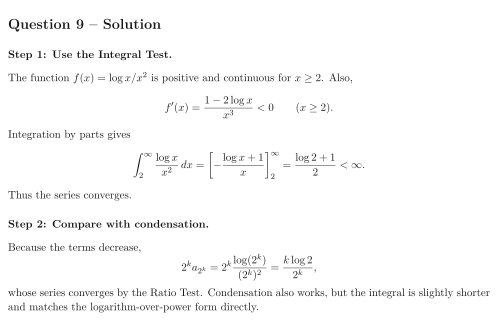
The function f(x)=log⁡x/x2f(x)=\log x/x^2 is positive and continuous for x≥2x\ge2. Also, f′(x)=1−2log⁡xx3<0(x≥2).f'(x)=\frac{1-2\log x}{x^3}<0\qquad(x\ge2). Integration by parts gives ∫2∞log⁡xx2dx=[−log⁡x+1x]2∞=log⁡2+12<∞.\int_2^{\infty}\frac{\log x}{x^2}\,dx=\left[-\frac{\log x+1}{x}\right]_2^{\infty}=\frac{\log2+1}{2}<\infty. Thus the series converges.

Step 2: Compare with condensation.

Because the terms decrease, 2ka2k=2klog⁡(2k)(2k)2=klog⁡22k,2^k a_{2^k}=2^k\frac{\log(2^k)}{(2^k)^2}=\frac{k\log2}{2^k}, whose series converges by the Ratio Test. Condensation also works, but the integral is slightly shorter and matches the logarithm-over-power form directly.

Original worksheet page 2: question and worked solution for 4-12-009

Original worksheet layout. Use Enlarge or open the PDF for a closer view.