Estimating the Value of a Series — Question 1

PDF ↗

Question 1

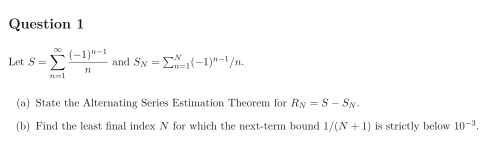
Let S=∑n=1∞(−1)n−1n\displaystyle S=\sum_{n=1}^{\infty}\frac{(-1)^{n-1}}n and SN=∑n=1N(−1)n−1/nS_N=\sum_{n=1}^{N}(-1)^{n-1}/n.

  1. State the Alternating Series Estimation Theorem for RN=S−SNR_N=S-S_N.

  2. Find the least final index NN for which the next-term bound 1/(N+1)1/(N+1) is strictly below 10−310^{-3}.

Original worksheet page 1: question and worked solution for 4-13-001
Show solutionHide solution

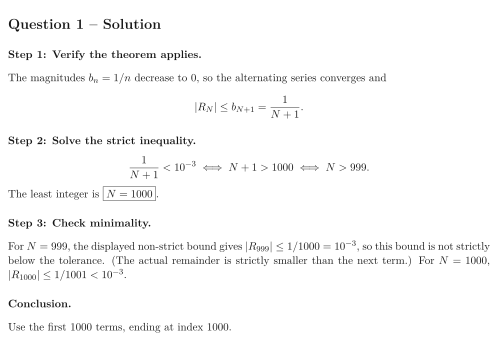
Question 1 – Solution

Step 1: Verify the theorem applies.

The magnitudes bn=1/nb_n=1/n decrease to 00, so the alternating series converges and |RN|≤bN+1=1N+1.|R_N|\le b_{N+1}=\frac1{N+1}.

Step 2: Solve the strict inequality.

1N+1<10−3⇔N+1>1000⇔N>999.\frac1{N+1}<10^{-3}\iff N+1>1000\iff N>999. The least integer is N=1000\boxed{N=1000}.

Step 3: Check minimality.

For N=999N=999, the displayed non-strict bound gives |R999|≤1/1000=10−3|R_{999}|\le1/1000=10^{-3}, so this bound is not strictly below the tolerance. (The actual remainder is strictly smaller than the next term.) For N=1000N=1000, |R1000|≤1/1001<10−3|R_{1000}|\le1/1001<10^{-3}.

Conclusion.

Use the first 10001000 terms, ending at index 10001000.

Original worksheet page 2: question and worked solution for 4-13-001

Original worksheet layout. Use Enlarge or open the PDF for a closer view.