Estimating the Value of a Series — Question 5

PDF ↗

Question 5

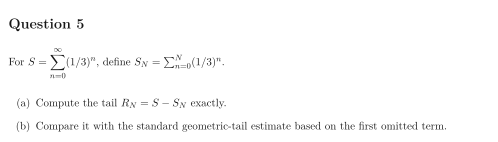
For S=∑n=0∞(1/3)n\displaystyle S=\sum_{n=0}^{\infty}(1/3)^n, define SN=∑n=0N(1/3)nS_N=\sum_{n=0}^{N}(1/3)^n.

  1. Compute the tail RN=S−SNR_N=S-S_N exactly.

  2. Compare it with the standard geometric-tail estimate based on the first omitted term.

Original worksheet page 1: question and worked solution for 4-13-005
Show solutionHide solution

Question 5 – Solution

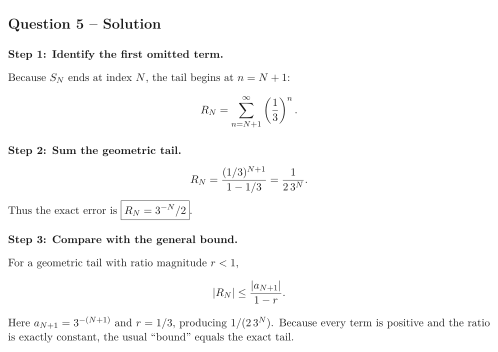
Step 1: Identify the first omitted term.

Because SNS_N ends at index NN, the tail begins at n=N+1n=N+1: RN=∑n=N+1∞(13)n.R_N=\sum_{n=N+1}^{\infty}\left(\frac13\right)^n.

Step 2: Sum the geometric tail.

RN=(1/3)N+11−1/3=123N.R_N=\frac{(1/3)^{N+1}}{1-1/3}=\frac{1}{2\,3^N}. Thus the exact error is RN=3−N/2\boxed{R_N=3^{-N}/2}.

Step 3: Compare with the general bound.

For a geometric tail with ratio magnitude r<1r<1, |RN|≤|aN+1|1−r.|R_N|\le\frac{|a_{N+1}|}{1-r}. Here aN+1=3−(N+1)a_{N+1}=3^{-(N+1)} and r=1/3r=1/3, producing 1/(23N)1/(2\,3^N). Because every term is positive and the ratio is exactly constant, the usual “bound” equals the exact tail.

Original worksheet page 2: question and worked solution for 4-13-005

Original worksheet layout. Use Enlarge or open the PDF for a closer view.