Estimating the Value of a Series — Question 10

PDF ↗

Question 10

For S=∑n=1∞2−n2\displaystyle S=\sum_{n=1}^{\infty}2^{-n^2} and SN=∑n=1N2−n2S_N=\sum_{n=1}^{N}2^{-n^2}, bound RN=S−SNR_N=S-S_N by a geometric series. Clearly identify its first term and common ratio.

Original worksheet page 1: question and worked solution for 4-13-010
Show solutionHide solution

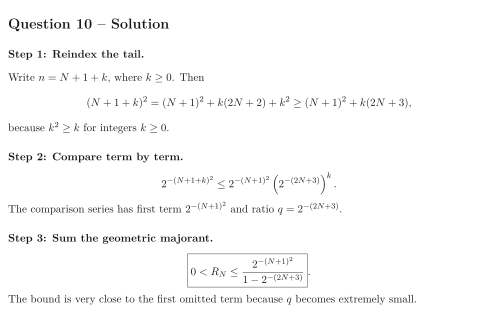
Question 10 – Solution

Step 1: Reindex the tail.

Write n=N+1+kn=N+1+k, where k≥0k\ge0. Then (N+1+k)2=(N+1)2+k(2N+2)+k2≥(N+1)2+k(2N+3),(N+1+k)^2=(N+1)^2+k(2N+2)+k^2\ge(N+1)^2+k(2N+3), because k2≥kk^2\ge k for integers k≥0k\ge0.

Step 2: Compare term by term.

2−(N+1+k)2≤2−(N+1)2(2−(2N+3))k.2^{-(N+1+k)^2}\le 2^{-(N+1)^2}\left(2^{-(2N+3)}\right)^k. The comparison series has first term 2−(N+1)22^{-(N+1)^2} and ratio q=2−(2N+3)q=2^{-(2N+3)}.

Step 3: Sum the geometric majorant.

0<RN≤2−(N+1)21−2−(2N+3).\boxed{0<R_N\le\frac{2^{-(N+1)^2}}{1-2^{-(2N+3)}}}. The bound is very close to the first omitted term because qq becomes extremely small.

Original worksheet page 2: question and worked solution for 4-13-010

Original worksheet layout. Use Enlarge or open the PDF for a closer view.