Taylor Series — Question 1

PDF ↗

Question 1

Construct the Maclaurin series for exe^x from its derivatives. Prove that it converges to exe^x for every real xx, and give a uniform Lagrange-remainder bound for the degree-NN polynomial on |x|≤1|x|\le1.

Original worksheet page 1: question and worked solution for 4-16-001
Show solutionHide solution

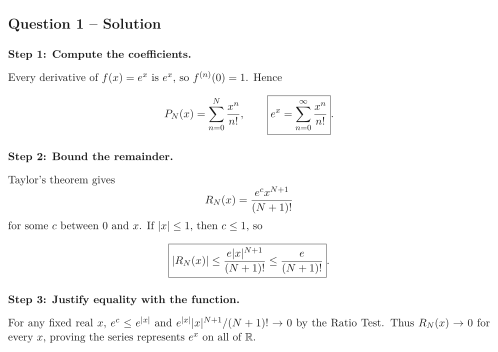
Question 1 – Solution

Step 1: Compute the coefficients.

Every derivative of f(x)=exf(x)=e^x is exe^x, so f(n)(0)=1f^{(n)}(0)=1. Hence PN(x)=∑n=0Nxnn!,ex=∑n=0∞xnn!.P_N(x)=\sum_{n=0}^{N}\frac{x^n}{n!},\qquad \boxed{e^x=\sum_{n=0}^{\infty}\frac{x^n}{n!}}.

Step 2: Bound the remainder.

Taylor’s theorem gives RN(x)=ecxN+1(N+1)!R_N(x)=\frac{e^c x^{N+1}}{(N+1)!} for some cc between 00 and xx. If |x|≤1|x|\le1, then c≤1c\le1, so |RN(x)|≤e|x|N+1(N+1)!≤e(N+1)!.\boxed{|R_N(x)|\le\frac{e|x|^{N+1}}{(N+1)!}\le\frac{e}{(N+1)!}}.

Step 3: Justify equality with the function.

For any fixed real xx, ec≤e|x|e^c\le e^{|x|} and e|x||x|N+1/(N+1)!→0e^{|x|}|x|^{N+1}/(N+1)!\to0 by the Ratio Test. Thus RN(x)→0R_N(x)\to0 for every xx, proving the series represents exe^x on all of ℝ\mathbb R.

Original worksheet page 2: question and worked solution for 4-16-001

Original worksheet layout. Use Enlarge or open the PDF for a closer view.