Taylor Series — Question 3

PDF ↗

Question 3

Derive the Maclaurin series for cos⁡x\cos x from its derivative cycle. Explain why every odd coefficient vanishes, give the degree-66 polynomial, and state the convergence domain.

Original worksheet page 1: question and worked solution for 4-16-003
Show solutionHide solution

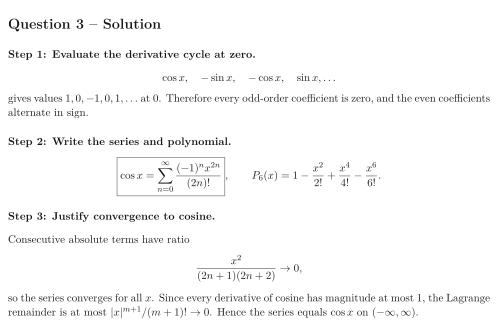
Question 3 – Solution

Step 1: Evaluate the derivative cycle at zero.

cos⁡x,−sin⁡x,−cos⁡x,sin⁡x,…\cos x,\quad-\sin x,\quad-\cos x,\quad\sin x,\ldots gives values 1,0,−1,0,1,…1,0,-1,0,1,\ldots at 00. Therefore every odd-order coefficient is zero, and the even coefficients alternate in sign.

Step 2: Write the series and polynomial.

cos⁡x=∑n=0∞(−1)nx2n(2n)!,P6(x)=1−x22!+x44!−x66!.\boxed{\cos x=\sum_{n=0}^{\infty}\frac{(-1)^n x^{2n}}{(2n)!}},\qquad P_6(x)=1-\frac{x^2}{2!}+\frac{x^4}{4!}-\frac{x^6}{6!}.

Step 3: Justify convergence to cosine.

Consecutive absolute terms have ratio x2(2n+1)(2n+2)→0,\frac{x^2}{(2n+1)(2n+2)}\to0, so the series converges for all xx. Since every derivative of cosine has magnitude at most 11, the Lagrange remainder is at most |x|m+1/(m+1)!→0|x|^{m+1}/(m+1)!\to0. Hence the series equals cos⁡x\cos x on (−∞,∞)(-\infty,\infty).

Original worksheet page 2: question and worked solution for 4-16-003

Original worksheet layout. Use Enlarge or open the PDF for a closer view.