Taylor Series — Question 6

PDF ↗

Question 6

Use cosh⁡x=(ex+e−x)/2\cosh x=(e^x+e^{-x})/2 to derive its Maclaurin series. Explain why all odd powers cancel, give the degree-66 polynomial, and state the convergence domain.

Original worksheet page 1: question and worked solution for 4-16-006
Show solutionHide solution

Question 6 – Solution

Step 1: Expand both exponentials.

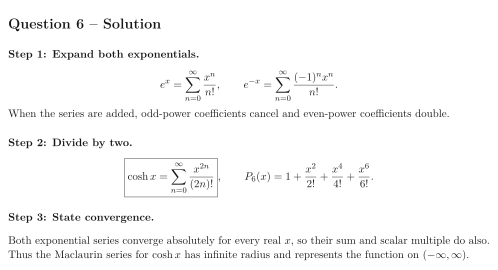
ex=∑n=0∞xnn!,e−x=∑n=0∞(−1)nxnn!.e^x=\sum_{n=0}^{\infty}\frac{x^n}{n!},\qquad e^{-x}=\sum_{n=0}^{\infty}\frac{(-1)^n x^n}{n!}. When the series are added, odd-power coefficients cancel and even-power coefficients double.

Step 2: Divide by two.

cosh⁡x=∑n=0∞x2n(2n)!,P6(x)=1+x22!+x44!+x66!.\boxed{\cosh x=\sum_{n=0}^{\infty}\frac{x^{2n}}{(2n)!}},\qquad P_6(x)=1+\frac{x^2}{2!}+\frac{x^4}{4!}+\frac{x^6}{6!}.

Step 3: State convergence.

Both exponential series converge absolutely for every real xx, so their sum and scalar multiple do also. Thus the Maclaurin series for cosh⁡x\cosh x has infinite radius and represents the function on (−∞,∞)(-\infty,\infty).

Original worksheet page 2: question and worked solution for 4-16-006

Original worksheet layout. Use Enlarge or open the PDF for a closer view.