Taylor Series — Question 8

PDF ↗

Question 8

Derive the Maclaurin series for f(x)=1/(1−x)f(x)=1/(1-x) from Taylor coefficients, then connect it with the finite geometric-sum identity. Determine the exact interval of convergence.

Original worksheet page 1: question and worked solution for 4-16-008
Show solutionHide solution

Question 8 – Solution

Step 1: Compute Taylor coefficients.

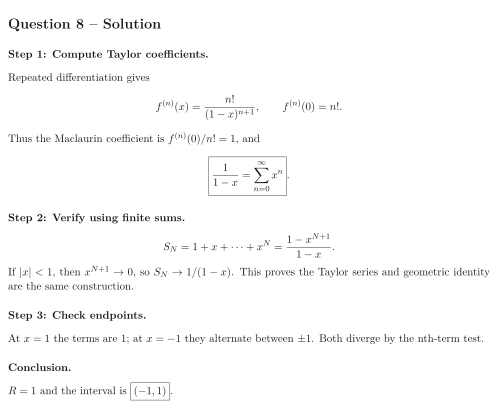
Repeated differentiation gives f(n)(x)=n!(1−x)n+1,f(n)(0)=n!.f^{(n)}(x)=\frac{n!}{(1-x)^{n+1}},\qquad f^{(n)}(0)=n!. Thus the Maclaurin coefficient is f(n)(0)/n!=1f^{(n)}(0)/n!=1, and 11−x=∑n=0∞xn.\boxed{\frac1{1-x}=\sum_{n=0}^{\infty}x^n}.

Step 2: Verify using finite sums.

SN=1+x+⋯+xN=1−xN+11−x.S_N=1+x+\cdots+x^N=\frac{1-x^{N+1}}{1-x}. If |x|<1|x|<1, then xN+1→0x^{N+1}\to0, so SN→1/(1−x)S_N\to1/(1-x). This proves the Taylor series and geometric identity are the same construction.

Step 3: Check endpoints.

At x=1x=1 the terms are 11; at x=−1x=-1 they alternate between ±1\pm1. Both diverge by the nth-term test.

Conclusion.

R=1R=1 and the interval is (−1,1)\boxed{(-1,1)}.

Original worksheet page 2: question and worked solution for 4-16-008

Original worksheet layout. Use Enlarge or open the PDF for a closer view.