Taylor Series — Question 10

PDF ↗

Question 10

Use complex exponentials to find the first four nonzero Maclaurin terms of excos⁡xe^x\cos x. Give a general coefficient formula and state the convergence domain.

Original worksheet page 1: question and worked solution for 4-16-010
Show solutionHide solution

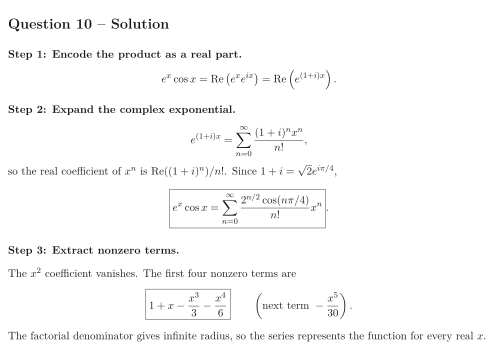
Question 10 – Solution

Step 1: Encode the product as a real part.

excos⁡x=Re⁡(exeix)=Re⁡(e(1+i)x).e^x\cos x=\operatorname{Re}\left(e^x e^{ix}\right)=\operatorname{Re}\left(e^{(1+i)x}\right).

Step 2: Expand the complex exponential.

e(1+i)x=∑n=0∞(1+i)nxnn!,e^{(1+i)x}=\sum_{n=0}^{\infty}\frac{(1+i)^n x^n}{n!}, so the real coefficient of xnx^n is Re⁡((1+i)n)/n!\operatorname{Re}((1+i)^n)/n!. Since 1+i=2eiπ/41+i=\sqrt2e^{i\pi/4}, excos⁡x=∑n=0∞2n/2cos⁡(nπ/4)n!xn.\boxed{e^x\cos x=\sum_{n=0}^{\infty}\frac{2^{n/2}\cos(n\pi/4)}{n!}x^n}.

Step 3: Extract nonzero terms.

The x2x^2 coefficient vanishes. The first four nonzero terms are 1+x−x33−x46(next term −x530).\boxed{1+x-\frac{x^3}{3}-\frac{x^4}{6}}\qquad\left(\text{next term }-\frac{x^5}{30}\right). The factorial denominator gives infinite radius, so the series represents the function for every real xx.

Original worksheet page 2: question and worked solution for 4-16-010

Original worksheet layout. Use Enlarge or open the PDF for a closer view.