Applications of Series — Question 9

PDF ↗

Question 9

A principal PP earns annual rate rr compounded nn times per year, so An=P(1+r/n)nA_n=P(1+r/n)^n. Use the series for log⁡(1+u)\log(1+u) to derive the continuous-compounding limit as n→∞n\to\infty.

Original worksheet page 1: question and worked solution for 4-17-009
Show solutionHide solution

Question 9 – Solution

Step 1: Take a logarithm.

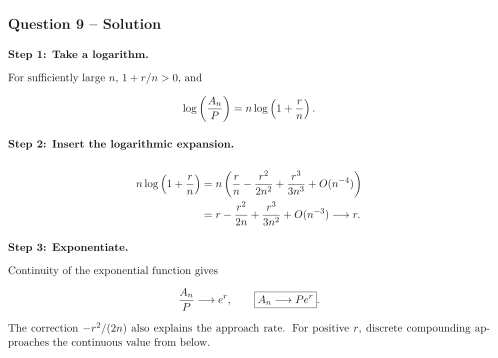
For sufficiently large nn, 1+r/n>01+r/n>0, and log⁡(AnP)=nlog⁡(1+rn).\log\left(\frac{A_n}{P}\right)=n\log\left(1+\frac rn\right).

Step 2: Insert the logarithmic expansion.

nlog⁡(1+rn)=n(rn−r22n2+r33n3+O(n−4))=r−r22n+r33n2+O(n−3)→r.\begin{align*} n\log\left(1+\frac rn\right)&=n\left(\frac rn-\frac{r^2}{2n^2}+\frac{r^3}{3n^3}+O(n^{-4})\right)\\&=r-\frac{r^2}{2n}+\frac{r^3}{3n^2}+O(n^{-3})\longrightarrow r. \end{align*}

Step 3: Exponentiate.

Continuity of the exponential function gives AnP→er,An→Per.\frac{A_n}{P}\longrightarrow e^r,\qquad\boxed{A_n\longrightarrow Pe^r}. The correction −r2/(2n)-r^2/(2n) also explains the approach rate. For positive rr, discrete compounding approaches the continuous value from below.

Original worksheet page 2: question and worked solution for 4-17-009

Original worksheet layout. Use Enlarge or open the PDF for a closer view.