Binomial Series — Question 10

PDF ↗

Question 10

Find the binomial series, radius, and exact interval of convergence for (1+3x)−1/2(1+3x)^{-1/2}. Test x=−1/3x=-1/3 and x=1/3x=1/3 separately.

Original worksheet page 1: question and worked solution for 4-18-010
Show solutionHide solution

Question 10 – Solution

Step 1: Substitute into the parent series.

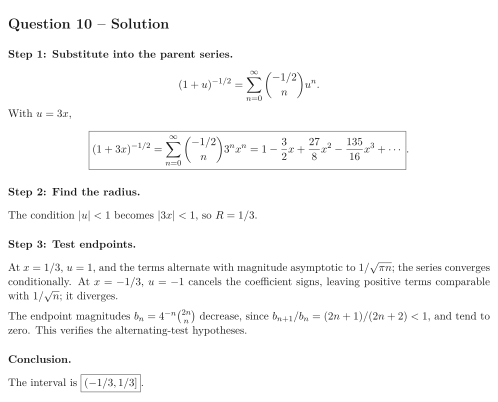
(1+u)−1/2=∑n=0∞(−1/2n)un.(1+u)^{-1/2}=\sum_{n=0}^{\infty}\binom{-1/2}{n}u^n. With u=3xu=3x, (1+3x)−1/2=∑n=0∞(−1/2n)3nxn=1−32x+278x2−13516x3+⋯.\boxed{(1+3x)^{-1/2}=\sum_{n=0}^{\infty}\binom{-1/2}{n}3^n x^n=1-\frac32x+\frac{27}{8}x^2-\frac{135}{16}x^3+\cdots}.

Step 2: Find the radius.

The condition |u|<1|u|<1 becomes |3x|<1|3x|<1, so R=1/3R=1/3.

Step 3: Test endpoints.

At x=1/3x=1/3, u=1u=1, and the terms alternate with magnitude asymptotic to 1/πn1/\sqrt{\pi n}; the series converges conditionally. At x=−1/3x=-1/3, u=−1u=-1 cancels the coefficient signs, leaving positive terms comparable with 1/n1/\sqrt n; it diverges.

The endpoint magnitudes bn=4−n(2nn)b_n=4^{-n}\binom{2n}{n} decrease, since bn+1/bn=(2n+1)/(2n+2)<1b_{n+1}/b_n=(2n+1)/(2n+2)<1, and tend to zero. This verifies the alternating-test hypotheses.

Conclusion.

The interval is (−1/3,1/3]\boxed{(-1/3,1/3]}.

Original worksheet page 2: question and worked solution for 4-18-010

Original worksheet layout. Use Enlarge or open the PDF for a closer view.