More on Sequences — Question 1

PDF ↗

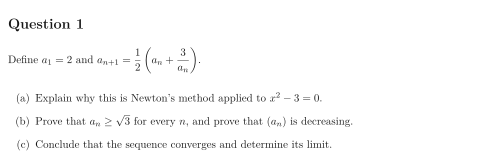
Question 1

Define a1=2a_1=2 and an+1=12(an+3an)a_{n+1}=\dfrac12\left(a_n+\dfrac3{a_n}\right).

  1. Explain why this is Newton’s method applied to x2−3=0x^2-3=0.

  2. Prove that an≥3a_n\ge\sqrt3 for every nn, and prove that (an)(a_n) is decreasing.

  3. Conclude that the sequence converges and determine its limit.
Original worksheet page 1: question and worked solution for 4-2-001
Show solutionHide solution

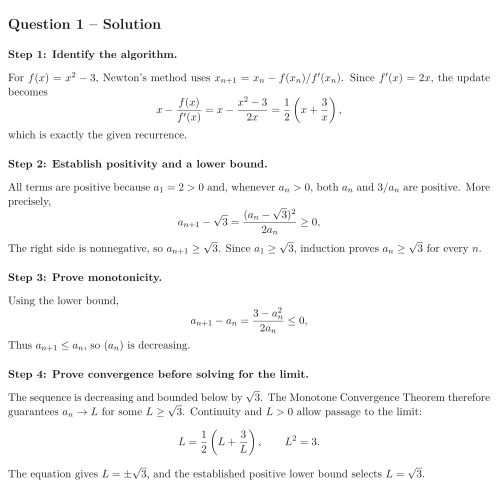
Question 1 – Solution

Step 1: Identify the algorithm.

For f(x)=x2−3f(x)=x^2-3, Newton’s method uses xn+1=xn−f(xn)/f′(xn)x_{n+1}=x_n-f(x_n)/f'(x_n). Since f′(x)=2xf'(x)=2x, the update becomes x−f(x)f′(x)=x−x2−32x=12(x+3x),x-\frac{f(x)}{f'(x)}=x-\frac{x^2-3}{2x}=\frac12\left(x+\frac3x\right), which is exactly the given recurrence.

Step 2: Establish positivity and a lower bound.

All terms are positive because a1=2>0a_1=2>0 and, whenever an>0a_n>0, both ana_n and 3/an3/a_n are positive. More precisely, an+1−3=(an−3)22an≥0,a_{n+1}-\sqrt3=\frac{(a_n-\sqrt3)^2}{2a_n}\ge0, The right side is nonnegative, so an+1≥3a_{n+1}\ge\sqrt3. Since a1≥3a_1\ge\sqrt3, induction proves an≥3a_n\ge\sqrt3 for every nn.

Step 3: Prove monotonicity.

Using the lower bound, an+1−an=3−an22an≤0,a_{n+1}-a_n=\frac{3-a_n^2}{2a_n}\le0, Thus an+1≤ana_{n+1}\le a_n, so (an)(a_n) is decreasing.

Step 4: Prove convergence before solving for the limit.

The sequence is decreasing and bounded below by 3\sqrt3. The Monotone Convergence Theorem therefore guarantees an→La_n\to L for some L≥3L\ge\sqrt3. Continuity and L>0L>0 allow passage to the limit: L=12(L+3L),L2=3.L=\frac12\left(L+\frac3L\right),\qquad L^2=3. The equation gives L=±3L=\pm\sqrt3, and the established positive lower bound selects L=3L=\sqrt3.

Original worksheet page 2: question and worked solution for 4-2-001

Original worksheet layout. Use Enlarge or open the PDF for a closer view.