More on Sequences — Question 5

PDF ↗

Question 5

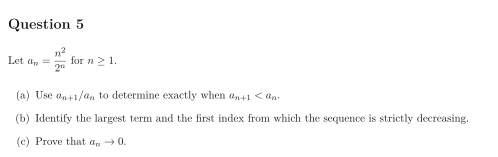
Let an=n22na_n=\dfrac{n^2}{2^n} for n≥1n\ge1.

  1. Use an+1/ana_{n+1}/a_n to determine exactly when an+1<ana_{n+1}<a_n.

  2. Identify the largest term and the first index from which the sequence is strictly decreasing.

  3. Prove that an→0a_n\to0.

Original worksheet page 1: question and worked solution for 4-2-005
Show solutionHide solution

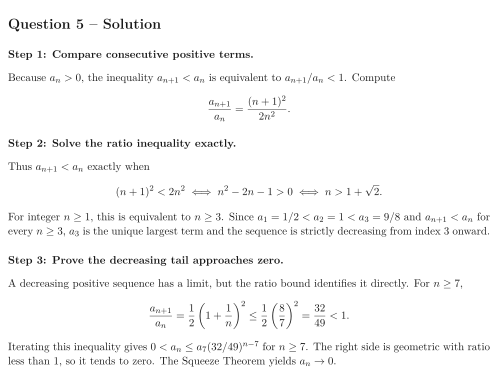
Question 5 – Solution

Step 1: Compare consecutive positive terms.

Because an>0a_n>0, the inequality an+1<ana_{n+1}<a_n is equivalent to an+1/an<1a_{n+1}/a_n<1. Compute an+1an=(n+1)22n2.\frac{a_{n+1}}{a_n}=\frac{(n+1)^2}{2n^2}.

Step 2: Solve the ratio inequality exactly.

Thus an+1<ana_{n+1}<a_n exactly when (n+1)2<2n2⇔n2−2n−1>0⇔n>1+2.(n+1)^2<2n^2\iff n^2-2n-1>0\iff n>1+\sqrt2. For integer n≥1n\ge1, this is equivalent to n≥3n\ge3. Since a1=1/2<a2=1<a3=9/8a_1=1/2<a_2=1<a_3=9/8 and an+1<ana_{n+1}<a_n for every n≥3n\ge3, a3a_3 is the unique largest term and the sequence is strictly decreasing from index 33 onward.

Step 3: Prove the decreasing tail approaches zero.

A decreasing positive sequence has a limit, but the ratio bound identifies it directly. For n≥7n\ge7, an+1an=12(1+1n)2≤12(87)2=3249<1.\frac{a_{n+1}}{a_n}=\frac12\left(1+\frac1n\right)^2\le\frac12\left(\frac87\right)^2=\frac{32}{49}<1. Iterating this inequality gives 0<an≤a7(32/49)n−70<a_n\le a_7(32/49)^{n-7} for n≥7n\ge7. The right side is geometric with ratio less than 11, so it tends to zero. The Squeeze Theorem yields an→0a_n\to0.

Original worksheet page 2: question and worked solution for 4-2-005

Original worksheet layout. Use Enlarge or open the PDF for a closer view.