More on Sequences — Question 9

PDF ↗

Question 9

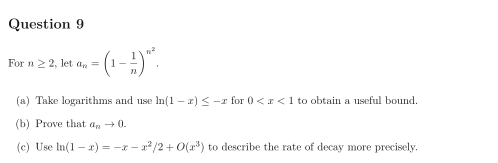
For n≥2n\ge2, let an=(1−1n)n2a_n=\left(1-\dfrac1n\right)^{n^2}.

  1. Take logarithms and use ln⁡(1−x)≤−x\ln(1-x)\le-x for 0<x<10<x<1 to obtain a useful bound.

  2. Prove that an→0a_n\to0.

  3. Use ln⁡(1−x)=−x−x2/2+O(x3)\ln(1-x)=-x-x^2/2+O(x^3) to describe the rate of decay more precisely.

Original worksheet page 1: question and worked solution for 4-2-009
Show solutionHide solution

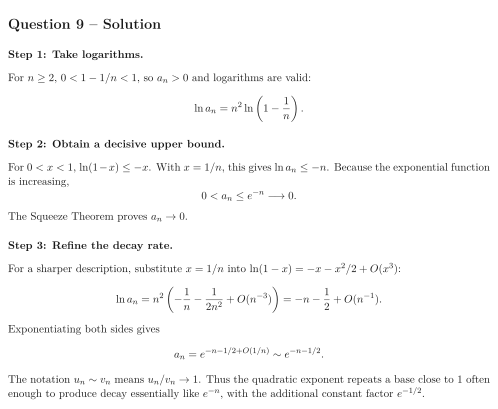
Question 9 – Solution

Step 1: Take logarithms.

For n≥2n\ge2, 0<1−1/n<10<1-1/n<1, so an>0a_n>0 and logarithms are valid: ln⁡an=n2ln⁡(1−1n).\ln a_n=n^2\ln\left(1-\frac1n\right).

Step 2: Obtain a decisive upper bound.

For 0<x<10<x<1, ln⁡(1−x)≤−x\ln(1-x)\le-x. With x=1/nx=1/n, this gives ln⁡an≤−n\ln a_n\le-n. Because the exponential function is increasing, 0<an≤e−n→0.0<a_n\le e^{-n}\longrightarrow0. The Squeeze Theorem proves an→0a_n\to0.

Step 3: Refine the decay rate.

For a sharper description, substitute x=1/nx=1/n into ln⁡(1−x)=−x−x2/2+O(x3)\ln(1-x)=-x-x^2/2+O(x^3): ln⁡an=n2(−1n−12n2+O(n−3))=−n−12+O(n−1).\ln a_n=n^2\left(-\frac1n-\frac1{2n^2}+O(n^{-3})\right) =-n-\frac12+O(n^{-1}). Exponentiating both sides gives an=e−n−1/2+O(1/n)∼e−n−1/2.a_n=e^{-n-1/2+O(1/n)}\sim e^{-n-1/2}. The notation un∼vnu_n\sim v_n means un/vn→1u_n/v_n\to1. Thus the quadratic exponent repeats a base close to 11 often enough to produce decay essentially like e−ne^{-n}, with the additional constant factor e−1/2e^{-1/2}.

Original worksheet page 2: question and worked solution for 4-2-009

Original worksheet layout. Use Enlarge or open the PDF for a closer view.