Series - The Basics — Question 5

PDF ↗

Question 5

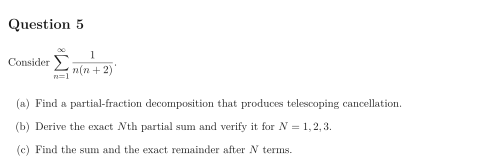
Consider ∑n=1∞1n(n+2)\displaystyle\sum_{n=1}^{\infty}\frac1{n(n+2)}.

  1. Find a partial-fraction decomposition that produces telescoping cancellation.

  2. Derive the exact NNth partial sum and verify it for N=1,2,3N=1,2,3.

  3. Find the sum and the exact remainder after NN terms.

Original worksheet page 1: question and worked solution for 4-3-005
Show solutionHide solution

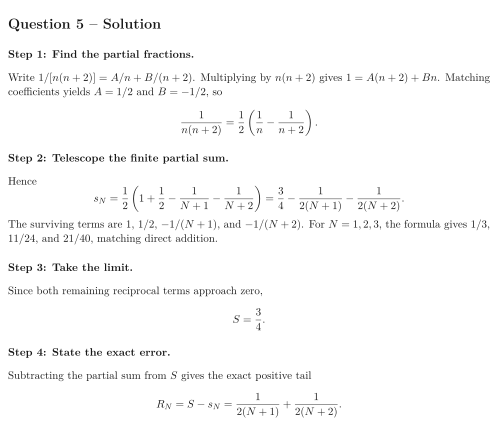
Question 5 – Solution

Step 1: Find the partial fractions.

Write 1/[n(n+2)]=A/n+B/(n+2)1/[n(n+2)]=A/n+B/(n+2). Multiplying by n(n+2)n(n+2) gives 1=A(n+2)+Bn1=A(n+2)+Bn. Matching coefficients yields A=1/2A=1/2 and B=−1/2B=-1/2, so 1n(n+2)=12(1n−1n+2).\frac1{n(n+2)}=\frac12\left(\frac1n-\frac1{n+2}\right).

Step 2: Telescope the finite partial sum.

Hence sN=12(1+12−1N+1−1N+2)=34−12(N+1)−12(N+2).s_N=\frac12\left(1+\frac12-\frac1{N+1}-\frac1{N+2}\right) =\frac34-\frac1{2(N+1)}-\frac1{2(N+2)}. The surviving terms are 11, 1/21/2, −1/(N+1)-1/(N+1), and −1/(N+2)-1/(N+2). For N=1,2,3N=1,2,3, the formula gives 1/31/3, 11/2411/24, and 21/4021/40, matching direct addition.

Step 3: Take the limit.

Since both remaining reciprocal terms approach zero, S=34.S=\frac34.

Step 4: State the exact error.

Subtracting the partial sum from SS gives the exact positive tail RN=S−sN=12(N+1)+12(N+2).R_N=S-s_N=\frac1{2(N+1)}+\frac1{2(N+2)}.

Original worksheet page 2: question and worked solution for 4-3-005

Original worksheet layout. Use Enlarge or open the PDF for a closer view.