Series - The Basics — Question 7

PDF ↗

Question 7

Evaluate ∑n=1∞n2n\displaystyle\sum_{n=1}^{\infty}\frac{n}{2^n}.

  1. Differentiate the geometric-series identity to derive a formula for ∑n=1∞nxn−1\sum_{n=1}^{\infty}nx^{n-1} when |x|<1|x|<1.

  2. Use that formula at x=1/2x=1/2 to evaluate the series.

  3. Derive the finite partial sum and exact remainder after NN terms.

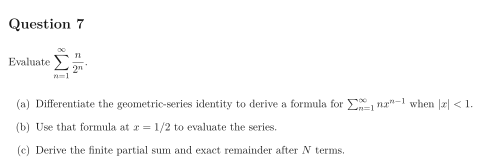
Original worksheet page 1: question and worked solution for 4-3-007
Show solutionHide solution

Question 7 – Solution

Step 1: Start from the geometric series.

For |x|<1|x|<1, the geometric identity is ∑n=0∞xn=11−x.\sum_{n=0}^{\infty}x^n=\frac1{1-x}.

Step 2: Differentiate within the interval of convergence.

Power series may be differentiated term by term at every interior point of their interval of convergence. Thus ∑n=1∞nxn−1=1(1−x)2.\sum_{n=1}^{\infty}nx^{n-1}=\frac1{(1-x)^2}. Multiplying both sides by xx aligns the power with the desired form: ∑n=1∞nxn=x(1−x)2.\sum_{n=1}^{\infty}nx^n=\frac{x}{(1-x)^2}.

Step 3: Substitute the required value.

Since |1/2|<1|1/2|<1, substitution is valid and gives (1/2)/(1/2)2=2(1/2)/(1/2)^2=2.

Step 4: Derive the finite sum and remainder.

Differentiating the finite identity 1+x+⋯+xN=(1−xN+1)/(1−x)1+x+\cdots+x^N=(1-x^{N+1})/(1-x) and multiplying by xx yields ∑n=1Nnxn=x−(N+1)xN+1+NxN+2(1−x)2.\sum_{n=1}^N nx^n=\frac{x-(N+1)x^{N+1}+Nx^{N+2}}{(1-x)^2}. At x=1/2x=1/2, this simplifies to sN=2−N+22N,RN=2−sN=N+22N.s_N=2-\frac{N+2}{2^N},\qquad R_N=2-s_N=\frac{N+2}{2^N}.

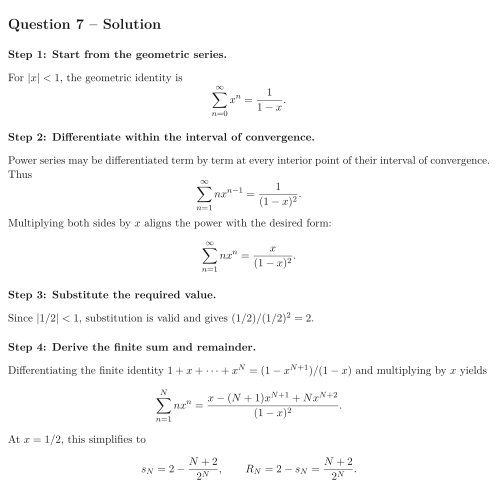
Original worksheet page 2: question and worked solution for 4-3-007

Original worksheet layout. Use Enlarge or open the PDF for a closer view.