Series - The Basics — Question 8

PDF ↗

Question 8

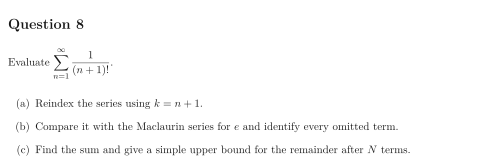
Evaluate ∑n=1∞1(n+1)!\displaystyle\sum_{n=1}^{\infty}\frac1{(n+1)!}.

  1. Reindex the series using k=n+1k=n+1.

  2. Compare it with the Maclaurin series for ee and identify every omitted term.

  3. Find the sum and give a simple upper bound for the remainder after NN terms.

Original worksheet page 1: question and worked solution for 4-3-008
Show solutionHide solution

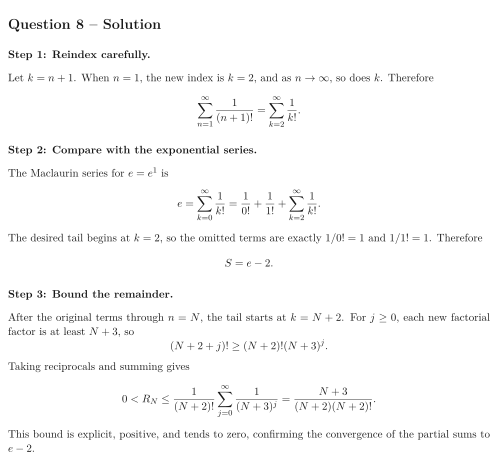
Question 8 – Solution

Step 1: Reindex carefully.

Let k=n+1k=n+1. When n=1n=1, the new index is k=2k=2, and as n→∞n\to\infty, so does kk. Therefore ∑n=1∞1(n+1)!=∑k=2∞1k!.\sum_{n=1}^{\infty}\frac1{(n+1)!}=\sum_{k=2}^{\infty}\frac1{k!}.

Step 2: Compare with the exponential series.

The Maclaurin series for e=e1e=e^1 is e=∑k=0∞1k!=10!+11!+∑k=2∞1k!.e=\sum_{k=0}^{\infty}\frac1{k!}=\frac1{0!}+\frac1{1!}+\sum_{k=2}^{\infty}\frac1{k!}. The desired tail begins at k=2k=2, so the omitted terms are exactly 1/0!=11/0!=1 and 1/1!=11/1!=1. Therefore S=e−2.S=e-2.

Step 3: Bound the remainder.

After the original terms through n=Nn=N, the tail starts at k=N+2k=N+2. For j≥0j\ge0, each new factorial factor is at least N+3N+3, so (N+2+j)!≥(N+2)!(N+3)j.(N+2+j)!\ge (N+2)!(N+3)^j. Taking reciprocals and summing gives 0<RN≤1(N+2)!∑j=0∞1(N+3)j=N+3(N+2)(N+2)!.0<R_N\le\frac1{(N+2)!}\sum_{j=0}^{\infty}\frac1{(N+3)^j} =\frac{N+3}{(N+2)(N+2)!}. This bound is explicit, positive, and tends to zero, confirming the convergence of the partial sums to e−2e-2.

Original worksheet page 2: question and worked solution for 4-3-008

Original worksheet layout. Use Enlarge or open the PDF for a closer view.