Question 1
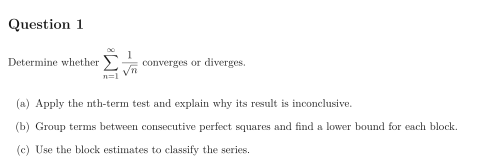
Determine whether converges or diverges.
Apply the nth-term test and explain why its result is inconclusive.
Group terms between consecutive perfect squares and find a lower bound for each block.
Use the block estimates to classify the series.
Show solutionHide solution
Question 1 – Solution
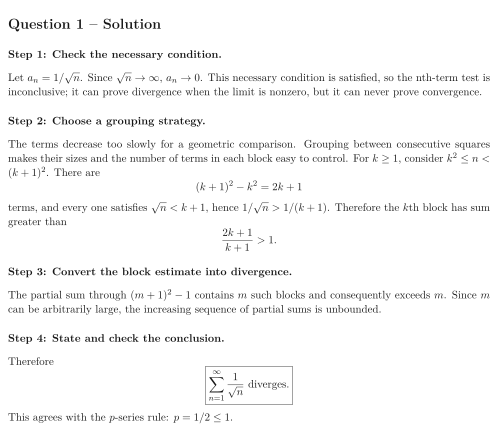
Step 1: Check the necessary condition.
Let . Since , . This necessary condition is satisfied, so the nth-term test is inconclusive; it can prove divergence when the limit is nonzero, but it can never prove convergence.
Step 2: Choose a grouping strategy.
The terms decrease too slowly for a geometric comparison. Grouping between consecutive squares makes their sizes and the number of terms in each block easy to control. For , consider . There are terms, and every one satisfies , hence . Therefore the th block has sum greater than
Step 3: Convert the block estimate into divergence.
The partial sum through contains such blocks and consequently exceeds . Since can be arbitrarily large, the increasing sequence of partial sums is unbounded.
Step 4: State and check the conclusion.
Therefore This agrees with the -series rule: .