Question 5
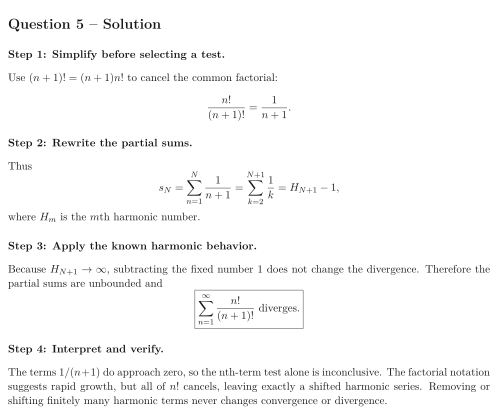
Determine whether converges or diverges.
Simplify the factorial quotient completely before selecting a test.
Express the th partial sum using harmonic numbers.
Classify the series and explain why its factorial notation is deceptive.
Show solutionHide solution
Question 5 – Solution
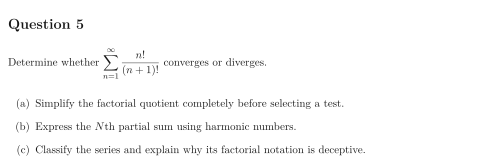
Step 1: Simplify before selecting a test.
Use to cancel the common factorial:
Step 2: Rewrite the partial sums.
Thus where is the th harmonic number.
Step 3: Apply the known harmonic behavior.
Because , subtracting the fixed number does not change the divergence. Therefore the partial sums are unbounded and
Step 4: Interpret and verify.
The terms do approach zero, so the nth-term test alone is inconclusive. The factorial notation suggests rapid growth, but all of cancels, leaving exactly a shifted harmonic series. Removing or shifting finitely many harmonic terms never changes convergence or divergence.