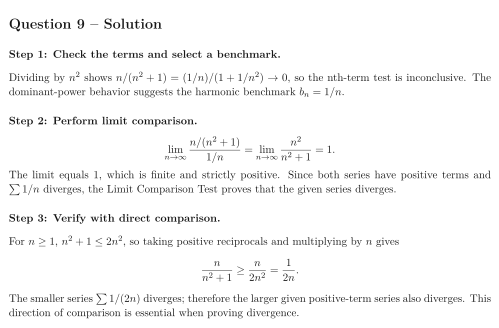
Question 9
Determine whether converges or diverges.
Verify the nth-term condition.
Perform a limit comparison with the harmonic series.
Give a direct lower comparison that independently proves divergence.
Show solutionHide solution
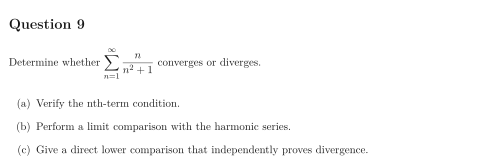
Question 9 – Solution
Step 1: Check the terms and select a benchmark.
Dividing by shows , so the nth-term test is inconclusive. The dominant-power behavior suggests the harmonic benchmark .
Step 2: Perform limit comparison.
The limit equals , which is finite and strictly positive. Since both series have positive terms and diverges, the Limit Comparison Test proves that the given series diverges.
Step 3: Verify with direct comparison.
For , , so taking positive reciprocals and multiplying by gives The smaller series diverges; therefore the larger given positive-term series also diverges. This direction of comparison is essential when proving divergence.