Special Series — Question 10

PDF ↗

Question 10

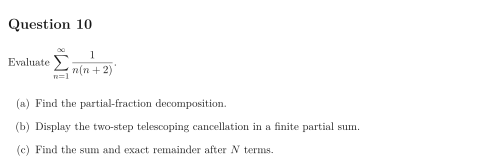
Evaluate ∑n=1∞1n(n+2)\displaystyle\sum_{n=1}^{\infty}\frac1{n(n+2)}.

  1. Find the partial-fraction decomposition.

  2. Display the two-step telescoping cancellation in a finite partial sum.

  3. Find the sum and exact remainder after NN terms.

Original worksheet page 1: question and worked solution for 4-5-010
Show solutionHide solution

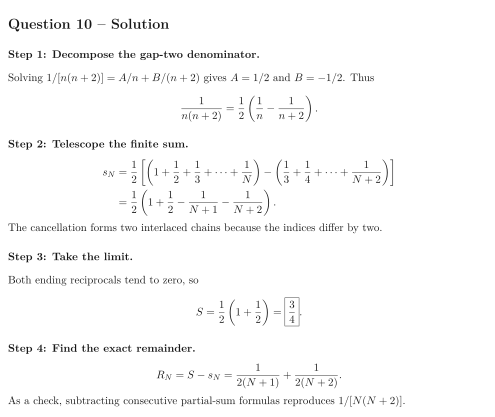
Question 10 – Solution

Step 1: Decompose the gap-two denominator.

Solving 1/[n(n+2)]=A/n+B/(n+2)1/[n(n+2)]=A/n+B/(n+2) gives A=1/2A=1/2 and B=−1/2B=-1/2. Thus 1n(n+2)=12(1n−1n+2).\frac1{n(n+2)}=\frac12\left(\frac1n-\frac1{n+2}\right).

Step 2: Telescope the finite sum.

sN=12[(1+12+13+⋯+1N)−(13+14+⋯+1N+2)]=12(1+12−1N+1−1N+2).\begin{aligned} s_N&=\frac12\left[\left(1+\frac12+\frac13+\cdots+\frac1N\right) -\left(\frac13+\frac14+\cdots+\frac1{N+2}\right)\right]\\ &=\frac12\left(1+\frac12-\frac1{N+1}-\frac1{N+2}\right). \end{aligned} The cancellation forms two interlaced chains because the indices differ by two.

Step 3: Take the limit.

Both ending reciprocals tend to zero, so S=12(1+12)=34.S=\frac12\left(1+\frac12\right)=\boxed{\frac34}.

Step 4: Find the exact remainder.

RN=S−sN=12(N+1)+12(N+2).R_N=S-s_N=\frac1{2(N+1)}+\frac1{2(N+2)}. As a check, subtracting consecutive partial-sum formulas reproduces 1/[N(N+2)]1/[N(N+2)].

Original worksheet page 2: question and worked solution for 4-5-010

Original worksheet layout. Use Enlarge or open the PDF for a closer view.