Question 1
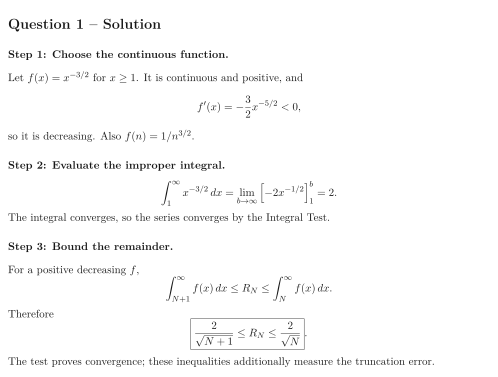
Consider the series
Define a continuous function with and verify that it is positive, continuous, and decreasing on the required interval.
Use the Integral Test to determine whether the series converges or diverges.
If is the th partial sum and , derive both an upper and a lower bound for .
Show the improper-integral limit and all antiderivative work.
Show solutionHide solution
Question 1 – Solution
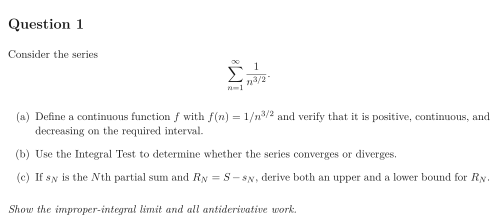
Step 1: Choose the continuous function.
Let for . It is continuous and positive, and so it is decreasing. Also .
Step 2: Evaluate the improper integral.
The integral converges, so the series converges by the Integral Test.
Step 3: Bound the remainder.
For a positive decreasing , Therefore The test proves convergence; these inequalities additionally measure the truncation error.