Integral Test — Question 2

PDF ↗

Question 2

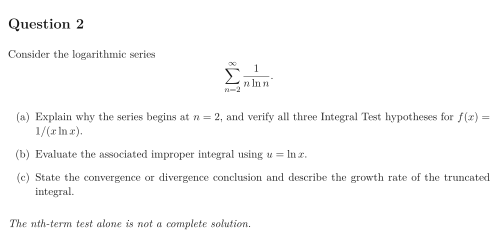
Consider the logarithmic series ∑n=2∞1nln⁡n.\sum_{n=2}^{\infty}\frac1{n\ln n}.

  1. Explain why the series begins at n=2n=2, and verify all three Integral Test hypotheses for f(x)=1/(xln⁡x)f(x)=1/(x\ln x).

  2. Evaluate the associated improper integral using u=ln⁡xu=\ln x.

  3. State the convergence or divergence conclusion and describe the growth rate of the truncated integral.

The nth-term test alone is not a complete solution.
Original worksheet page 1: question and worked solution for 4-6-002
Show solutionHide solution

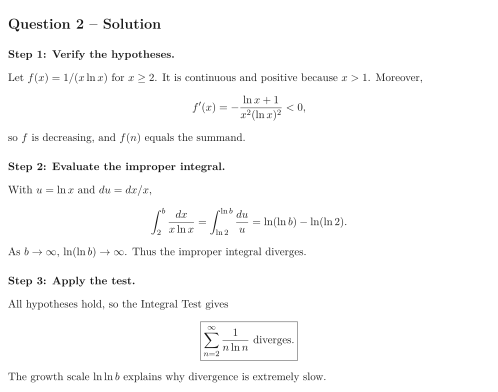
Question 2 – Solution

Step 1: Verify the hypotheses.

Let f(x)=1/(xln⁡x)f(x)=1/(x\ln x) for x≥2x\ge2. It is continuous and positive because x>1x>1. Moreover, f′(x)=−ln⁡x+1x2(ln⁡x)2<0,f'(x)=-\frac{\ln x+1}{x^2(\ln x)^2}<0, so ff is decreasing, and f(n)f(n) equals the summand.

Step 2: Evaluate the improper integral.

With u=ln⁡xu=\ln x and du=dx/xdu=dx/x, ∫2bdxxln⁡x=∫ln⁡2ln⁡bduu=ln⁡(ln⁡b)−ln⁡(ln⁡2).\int_2^b\frac{dx}{x\ln x}=\int_{\ln2}^{\ln b}\frac{du}{u} =\ln(\ln b)-\ln(\ln2). As b→∞b\to\infty, ln⁡(ln⁡b)→∞\ln(\ln b)\to\infty. Thus the improper integral diverges.

Step 3: Apply the test.

All hypotheses hold, so the Integral Test gives ∑n=2∞1nln⁡n diverges.\boxed{\sum_{n=2}^{\infty}\frac1{n\ln n}\text{ diverges}.} The growth scale ln⁡ln⁡b\ln\ln b explains why divergence is extremely slow.
Original worksheet page 2: question and worked solution for 4-6-002

Original worksheet layout. Use Enlarge or open the PDF for a closer view.