Integral Test — Question 10

PDF ↗

Question 10

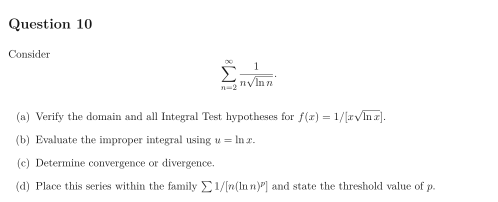
Consider ∑n=2∞1nln⁡n.\sum_{n=2}^{\infty}\frac1{n\sqrt{\ln n}}.

  1. Verify the domain and all Integral Test hypotheses for f(x)=1/[xln⁡x]f(x)=1/[x\sqrt{\ln x}].

  2. Evaluate the improper integral using u=ln⁡xu=\ln x.

  3. Determine convergence or divergence.

  4. Place this series within the family ∑1/[n(ln⁡n)p]\sum 1/[n(\ln n)^p] and state the threshold value of pp.

Original worksheet page 1: question and worked solution for 4-6-010
Show solutionHide solution

Question 10 – Solution

Step 1: Verify the hypotheses.

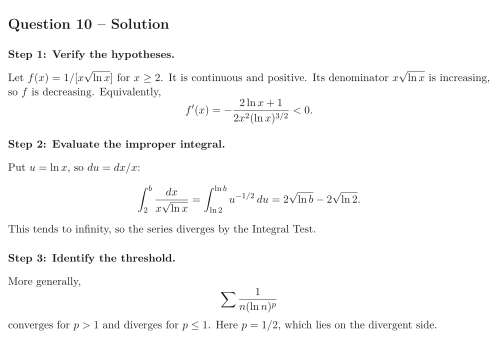
Let f(x)=1/[xln⁡x]f(x)=1/[x\sqrt{\ln x}] for x≥2x\ge2. It is continuous and positive. Its denominator xln⁡xx\sqrt{\ln x} is increasing, so ff is decreasing. Equivalently, f′(x)=−2ln⁡x+12x2(ln⁡x)3/2<0.f'(x)=-\frac{2\ln x+1}{2x^2(\ln x)^{3/2}}<0.

Step 2: Evaluate the improper integral.

Put u=ln⁡xu=\ln x, so du=dx/xdu=dx/x: ∫2bdxxln⁡x=∫ln⁡2ln⁡bu−1/2du=2ln⁡b−2ln⁡2.\int_2^b\frac{dx}{x\sqrt{\ln x}} =\int_{\ln2}^{\ln b}u^{-1/2}\,du =2\sqrt{\ln b}-2\sqrt{\ln2}. This tends to infinity, so the series diverges by the Integral Test.

Step 3: Identify the threshold.

More generally, ∑1n(ln⁡n)p\sum\frac1{n(\ln n)^p} converges for p>1p>1 and diverges for p≤1p\le1. Here p=1/2p=1/2, which lies on the divergent side.

Original worksheet page 2: question and worked solution for 4-6-010

Original worksheet layout. Use Enlarge or open the PDF for a closer view.