Question 1
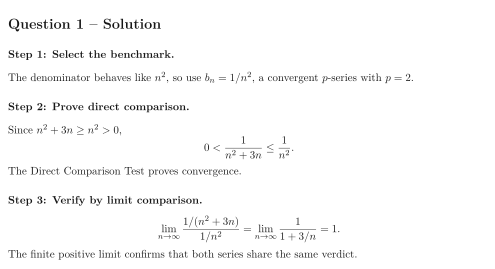
Consider .
Identify the dominant power and select a standard benchmark.
Prove a direct-comparison inequality with the correct direction.
Classify the series and confirm the result by limit comparison.
State why the benchmark converges or diverges.
Show solutionHide solution
Question 1 – Solution
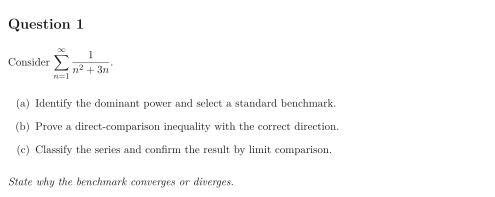
Step 1: Select the benchmark.
The denominator behaves like , so use , a convergent -series with .
Step 2: Prove direct comparison.
Since , The Direct Comparison Test proves convergence.
Step 3: Verify by limit comparison.
The finite positive limit confirms that both series share the same verdict.