Comparison and Limit Comparison Tests — Question 6

PDF ↗

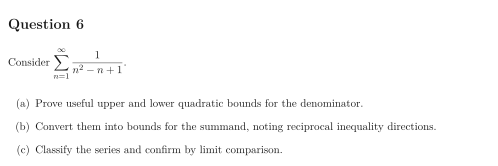
Question 6

Consider ∑n=1∞1n2−n+1\displaystyle\sum_{n=1}^{\infty}\frac1{n^2-n+1}.

  1. Prove useful upper and lower quadratic bounds for the denominator.

  2. Convert them into bounds for the summand, noting reciprocal inequality directions.

  3. Classify the series and confirm by limit comparison.
Original worksheet page 1: question and worked solution for 4-7-006
Show solutionHide solution

Question 6 – Solution

Step 1: Bound the denominator.

Clearly n2−n+1≤n2n^2-n+1\le n^2. Also n2−n+1≥n22⇔n2−2n+2=(n−1)2+1≥0.n^2-n+1\ge\frac{n^2}{2} \iff n^2-2n+2=(n-1)^2+1\ge0. Thus n2/2≤n2−n+1≤n2n^2/2\le n^2-n+1\le n^2.

Step 2: Take reciprocals carefully.

All expressions are positive, so reciprocals reverse the inequalities: 1n2≤1n2−n+1≤2n2.\frac1{n^2}\le\frac1{n^2-n+1}\le\frac2{n^2}. The upper bound is the decisive one for convergence. Since ∑2/n2\sum2/n^2 converges, Direct Comparison proves convergence.

Step 3: Confirm asymptotically.
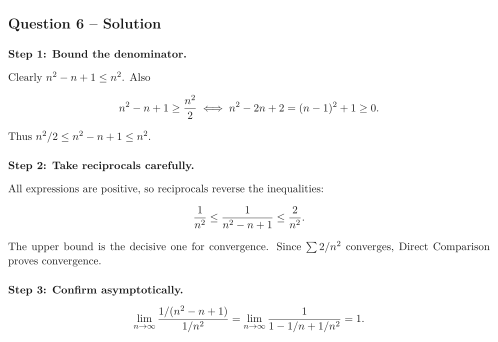
limn→∞1/(n2−n+1)1/n2=limn→∞11−1/n+1/n2=1.\lim_{n\to\infty}\frac{1/(n^2-n+1)}{1/n^2} =\lim_{n\to\infty}\frac1{1-1/n+1/n^2}=1.

Original worksheet page 2: question and worked solution for 4-7-006

Original worksheet layout. Use Enlarge or open the PDF for a closer view.