Comparison and Limit Comparison Tests — Question 10

PDF ↗

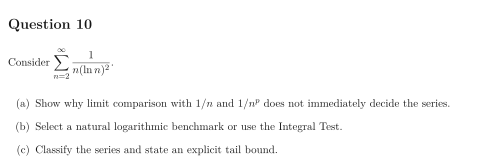
Question 10

Consider ∑n=2∞1n(ln⁡n)2\displaystyle\sum_{n=2}^{\infty}\frac1{n(\ln n)^2}.

  1. Show why limit comparison with 1/n1/n and 1/np1/n^p does not immediately decide the series.

  2. Select a natural logarithmic benchmark or use the Integral Test.

  3. Classify the series and state an explicit tail bound.
Original worksheet page 1: question and worked solution for 4-7-010
Show solutionHide solution

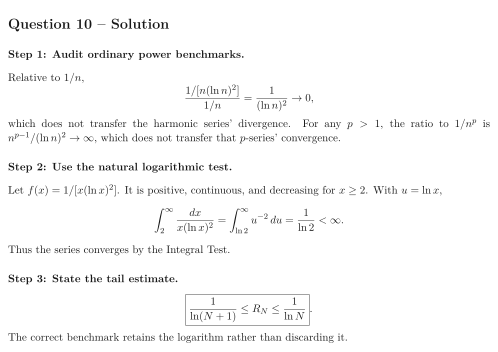
Question 10 – Solution

Step 1: Audit ordinary power benchmarks.

Relative to 1/n1/n, 1/[n(ln⁡n)2]1/n=1(ln⁡n)2→0,\frac{1/[n(\ln n)^2]}{1/n}=\frac1{(\ln n)^2}\to0, which does not transfer the harmonic series’ divergence. For any p>1p>1, the ratio to 1/np1/n^p is np−1/(ln⁡n)2→∞n^{p-1}/(\ln n)^2\to\infty, which does not transfer that pp-series’ convergence.

Step 2: Use the natural logarithmic test.

Let f(x)=1/[x(ln⁡x)2]f(x)=1/[x(\ln x)^2]. It is positive, continuous, and decreasing for x≥2x\ge2. With u=ln⁡xu=\ln x, ∫2∞dxx(ln⁡x)2=∫ln⁡2∞u−2du=1ln⁡2<∞.\int_2^{\infty}\frac{dx}{x(\ln x)^2} =\int_{\ln2}^{\infty}u^{-2}\,du=\frac1{\ln2}<\infty. Thus the series converges by the Integral Test.

Step 3: State the tail estimate.

1ln⁡(N+1)≤RN≤1ln⁡N.\boxed{\frac1{\ln(N+1)}\le R_N\le\frac1{\ln N}}. The correct benchmark retains the logarithm rather than discarding it.
Original worksheet page 2: question and worked solution for 4-7-010

Original worksheet layout. Use Enlarge or open the PDF for a closer view.