Alternating Series Test — Question 8

PDF ↗

Question 8

Consider ∑n=1∞(−1)nln⁡(n+1)\displaystyle\sum_{n=1}^{\infty}\frac{(-1)^n}{\ln(n+1)}.

  1. Verify decrease without differentiating.

  2. Apply the AST.

  3. Test absolute convergence and classify the series.
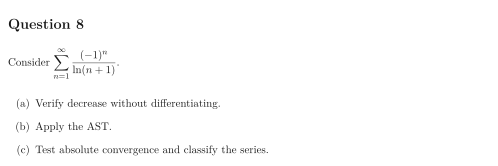
Original worksheet page 1: question and worked solution for 4-8-008
Show solutionHide solution

Question 8 – Solution

Step 1: Verify monotonicity.

Since n+2>n+1n+2>n+1 and logarithm is strictly increasing, ln⁡(n+2)>ln⁡(n+1)>0.\ln(n+2)>\ln(n+1)>0. Taking positive reciprocals reverses the inequality, so bn+1<bnb_{n+1}<b_n for bn=1/ln⁡(n+1)b_n=1/\ln(n+1).

Step 2: Check the limit and apply AST.

Because ln⁡(n+1)→∞\ln(n+1)\to\infty, bn→0b_n\to0. Thus the alternating series converges.

Step 3: Test absolute convergence.

Since ln⁡(n+1)≤n\ln(n+1)\le n for n≥1n\ge1, 1ln⁡(n+1)≥1n.\frac1{\ln(n+1)}\ge\frac1n. The absolute series diverges by comparison with the harmonic series. Therefore convergence is conditional.
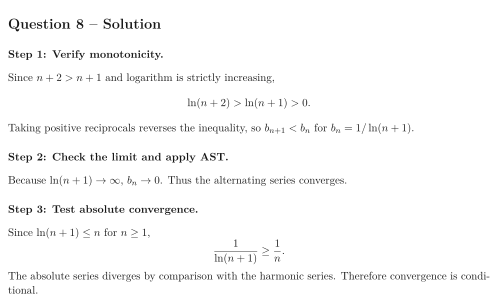
Original worksheet page 2: question and worked solution for 4-8-008

Original worksheet layout. Use Enlarge or open the PDF for a closer view.