Alternating Series Test — Question 10
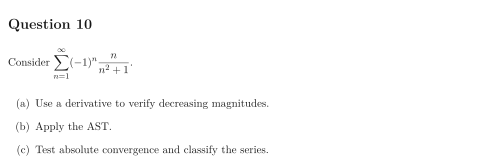
Question 10
Consider
.
Use a derivative to verify decreasing magnitudes.
Apply the AST.
Test absolute convergence and classify the series.
Show solutionHide solution+
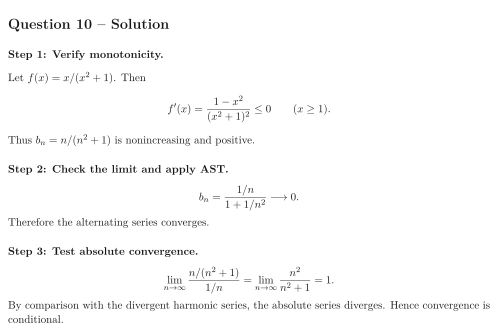
Question 10 –
Solution
Step 1: Verify monotonicity.
Let
.
Then
Thus
is nonincreasing and positive.
Step 2: Check the limit
and apply AST.
Therefore the alternating series converges.
Step 3: Test absolute
convergence.
By comparison with the divergent harmonic series, the absolute series
diverges. Hence convergence is conditional.
Original worksheet layout. Use Enlarge or open the PDF for a closer view.