Question 1
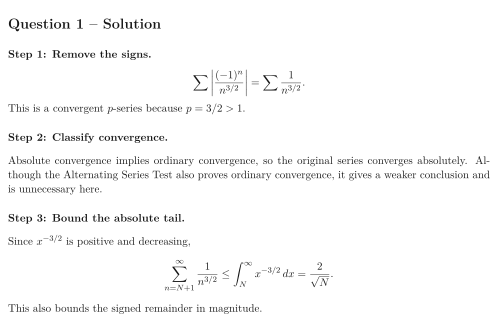
Consider .
Test the absolute-value series first.
Classify the original series and identify the strongest efficient theorem.
Give an upper bound for the absolute tail after terms.
Show solutionHide solution
Question 1 – Solution
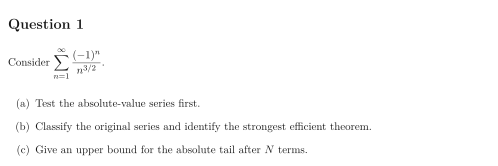
Step 1: Remove the signs.
This is a convergent -series because .
Step 2: Classify convergence.
Absolute convergence implies ordinary convergence, so the original series converges absolutely. Although the Alternating Series Test also proves ordinary convergence, it gives a weaker conclusion and is unnecessary here.
Step 3: Bound the absolute tail.
Since is positive and decreasing, This also bounds the signed remainder in magnitude.